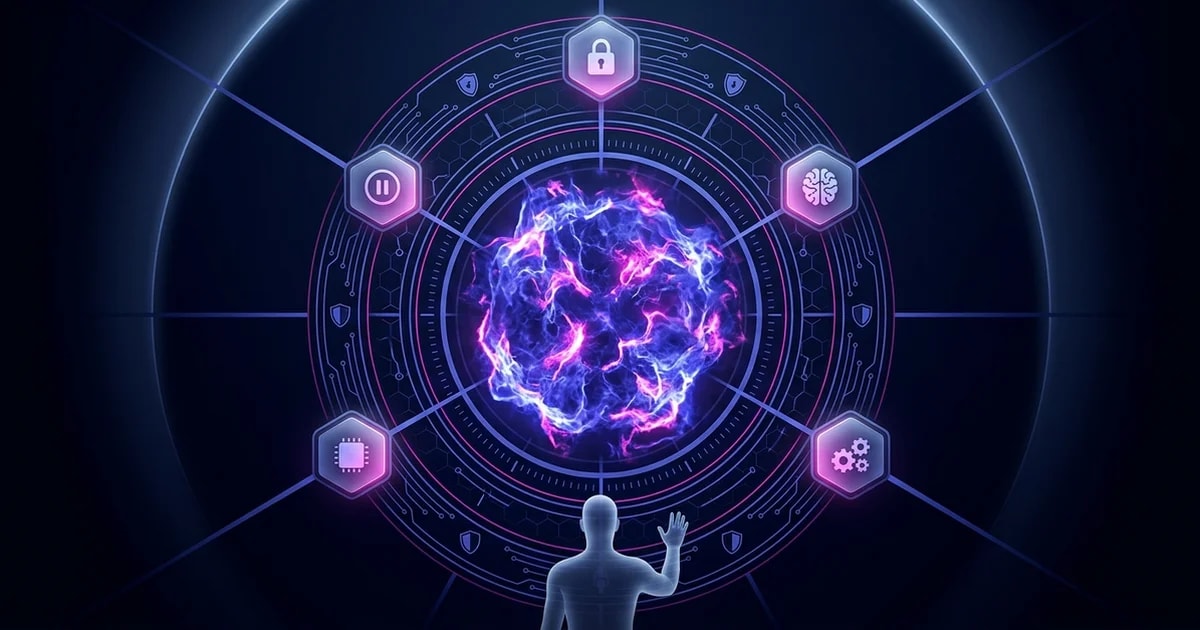
We are witnessing a collective hallucination in the software engineering world. Every day, the industry hyperventilates over the latest Large Language Model (LLM) parameter counts, benchmark scores, and context window sizes. Developers are treating raw intelligence as if it is the final product. But as an agentic engineering zealot, I am here to tell you that dropping a massive, raw cognitive engine into an enterprise environment is like dropping a Formula 1 engine onto a skateboard. It is fast, it is unpredictable, and it will inevitably crash into a wall. The engine is irrelevant if you cannot steer it, fuel it, cool it, and stop it.
The true revolution, the discipline that will define the next decade of enterprise software, is not model training. It is Harness Engineering.
Harness engineering is the rigorous, architectural discipline of building the integration, orchestration, routing, and guardrail layers around raw AI models. It is the science of bounding the probabilistic nature of AI with deterministic code. Without a proper harness, AI is just a parlor trick. With a harness, AI becomes an autonomous, governed agent capable of fundamentally reshaping enterprise operations. Let's spend some time breaking down the core concepts of harness engineering, what it requires, and why it is the only path forward.
The Core Concepts of Harness Engineering
To build a true agentic AI system, you must construct a multi-layered harness that dictates how the model perceives, thinks, remembers, acts, and pauses.
1. The Execution Environment: Absolute Sovereignty
A harness begins with the physical and logical environment in which the model operates. You cannot claim to have engineered a secure harness if your cognitive engine is constantly calling out to public APIs, leaking trade secrets, and exposing personally identifiable information (PII) to third-party servers.
A true harness must be capable of absolute isolation. This means engineering an architecture that can be deployed entirely on-premises or within a private cloud, ensuring complete data sovereignty. A properly engineered harness relies on hardened, secure infrastructure: containerized deployments with strict network segmentation, isolating the control plane, data plane, and management plane. It requires rigorous secrets management to ensure that API keys, database credentials, and encryption keys are injected securely and never exposed. If the enterprise requires it, the harness must be able to operate in a fully air-gapped environment, severing all external connectivity while retaining full autonomous capability.
2. The Connective Tissue: Standardized Perception and Action
A brain in a jar cannot act. A model without tools is just a chatbot. Harness engineering demands the creation of a standardized, universal integration layer, often conceptualized today as the Model Context Protocol (MCP).
This connective tissue allows the agent to perceive its environment by standardizing how it interacts with external data sources, legacy systems, and APIs. Instead of writing bespoke, fragile glue code for every new application, a harness uses this protocol to expose enterprise systems (like CRM databases, cloud billing, HR systems, or ticketing platforms) as dynamic tools.
This enables a paradigm shift known as Dynamically Composable Software. When the harness perfectly abstracts the underlying systems, the AI agent can combine existing application capabilities on the fly to create entirely new workflows. The agent can perceive a problem, query a database, read a policy document, and execute an API call to resolve the issue, all because the harness engineered the pathways for it to do so safely.
3. Execution Frameworks: ReAct and CodeAct
The engine must be taught how to think within the bounds of the enterprise. This is where execution frameworks come in.
The ReAct (Reasoning and Acting) framework is a foundational piece of the harness. It forces the model to slow down and show its work. Instead of just blurting out an answer, the harness forces the model into a loop: observe the input, explain its logical reasoning, choose a tool, act, observe the result of that action, and reason again. This line-of-thought logging is essential for auditability; if an agent makes a decision, the harness must record exactly why it made that decision.
But ReAct is not enough for advanced automation. The pinnacle of execution engineering is CodeAct. Rather than relying solely on pre-written API wrappers, a CodeAct-enabled harness provides the model with a secure, sandboxed environment (typically Python-based) to generate and execute code dynamically. This gives the agent the ability to build its own tools in real-time, performing complex data transformations or remote diagnostics that a static API could never handle.
4. Orchestration: The Engine Management System
You cannot run an enterprise on a handful of isolated, rogue agents. You need a master scheduler: a robust orchestration layer.
Harness engineering utilizes enterprise-grade agentic workflow orchestrators to manage complex, multi-step processes. This layer handles parallel execution, conditional escalations, and automated retries. If an agent fails to complete a task due to an API timeout, the harness must know how to catch that error, back off and retry, or gracefully escalate the failure.
Furthermore, orchestration dictates multi-agent architecture. A properly engineered harness supports the Manager Pattern, where a central coordinating agent distributes tasks to specialized worker agents (e.g., an SRE agent and a Help Desk agent), synthesizing their results. Alternatively, it supports the Decentralized Pattern, allowing specialized agents to hand off tasks directly to peers without a central bottleneck. This flexibility is what allows agents to scale from simple automations to complex, interdependent enterprise workflows.
5. The Hippocampus: Retrieval-Augmented Generation (RAG) and Vector Memory
Agents must have memory. A harness engineers this memory through embedded Vector Databases.
This is not a simple search index. The vector database transforms unstructured enterprise data (PDFs, policies, incident logs) into high-dimensional mathematical embeddings. When an agent needs context, the harness performs a semantic search, retrieving only the most relevant snippets of data to inject into the model's prompt.
More importantly, the vector database serves as the agent's long-term memory. It stores conversation histories, user intents, and past successful interactions as embeddings. This allows the agent to recognize historical patterns, maintain context over weeks or months, and detect anomalies by comparing current system states against historical baselines.
6. The Brakes: Guardrails and Human-in-the-Loop (HITL)
Finally, and most crucially, harness engineering is about the brakes. Autonomy without controls is a liability.
Before a model's output ever reaches a user or an API, the harness must run it through a gauntlet of AI/ML security guardrails. This includes safety classifiers to detect prompt injections, relevance classifiers to ensure the agent hasn't drifted off-topic, PII filters to redact sensitive data, and output validation to ensure compliance with business rules.
When the agent encounters a high-risk action, such as closing a critical ticket, making a production configuration change, or issuing a massive refund, the harness must physically halt the execution. This is the Human-in-the-Loop (HITL) requirement. The harness must suspend the agent's state, reach out to a human via secure channels (like a time-bound web link, a One-Time Password via SMS, or an interactive message in Slack or Microsoft Teams), wait for explicit approval, and then securely resume the workflow.
How lowtouch.ai Addresses This: The Ultimate Reference Architecture
You can spend millions of dollars and years of engineering time trying to build the harness I just described from scratch, stitching together disparate open-source tools. Or, you can look at the definitive reference architecture for the agentic age: lowtouch.ai.
lowtouch.ai is a no-code, agentic AI platform that has perfectly operationalized the concept of harness engineering. It is designed from the ground up to solve the enterprise AI problems of complexity, costs, privacy, and control, taking enterprises from idea to governed production agents in just 4 to 6 weeks.
Here is exactly how the lowtouch.ai appliance architecture implements the perfect harness:
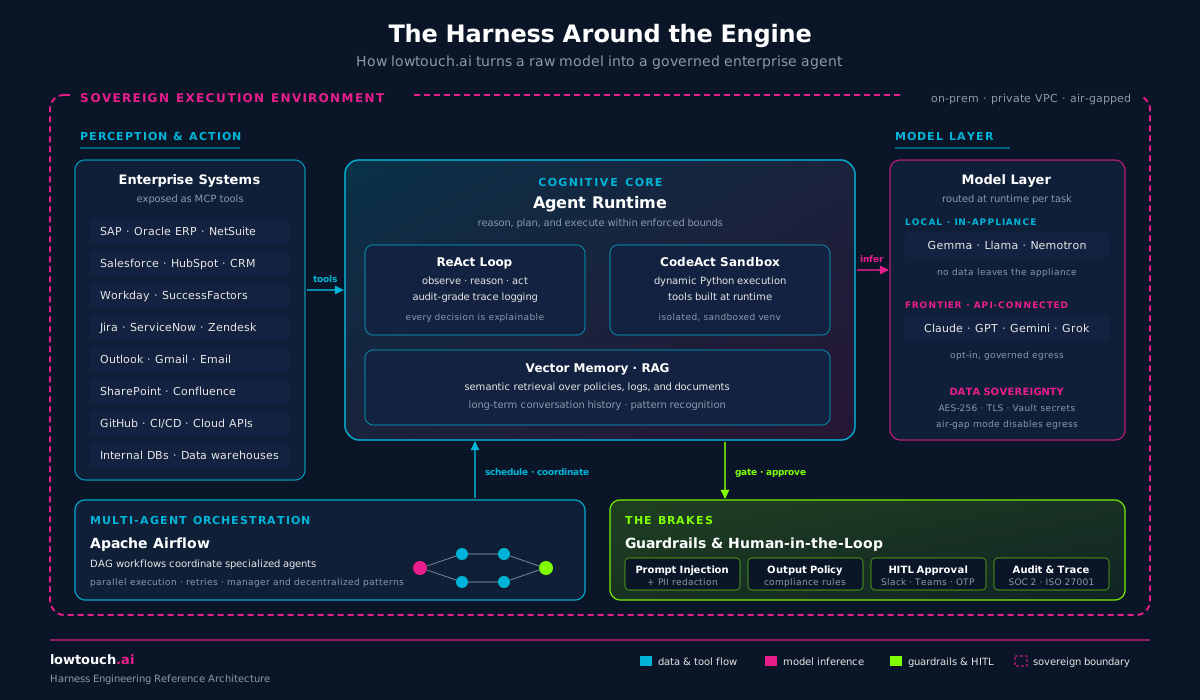
The Secure Sandbox: lowtouch.ai is a self-contained appliance deployed entirely on-premises or within a private cloud Virtual Private Cloud (VPC). It guarantees absolute data sovereignty: no data ever leaves your environment. The platform utilizes a deeply hardened container stack, relying on HashiCorp Vault for AppRole-authenticated secrets management, PostgreSQL 15.1 for state, and Redis for caching, all secured with AES-256 encryption at rest and TLS 1.2+ in transit. For ultimate privacy, the harness includes an internal Ollama container to host LLMs like Nemotron 70B and Llama 3.1 8B completely privately, supporting true air-gapped deployments.
Connective Tissue and Orchestration: To achieve dynamic composability, lowtouch.ai leverages the Model Context Protocol (MCP) via its agent connector container, exposing enterprise systems like Jira, ServiceNow, and internal databases as standardized tools. The heavy lifting of orchestration is handled by integrating Apache Airflow, structuring agentic workflows as resilient, parallelizable pipelines capable of sequential monitoring and concurrent execution. Within the agentic runtime, the platform natively executes both the ReAct and CodeAct frameworks, allowing agents to analyze, reason, and dynamically execute Python code for complex automation tasks. Furthermore, it natively supports both Manager and Decentralized multi-agent patterns.
Memory and Guardrails: The lowtouch.ai harness embeds its own vector database to handle semantic search and RAG, allowing agents to maintain long-term conversational context and perform anomaly detection across aggregated cross-system data. Finally, lowtouch.ai's implementation of "The Brakes" is unparalleled. It embeds mandatory Human-in-the-Loop (HITL) workflows, halting high-risk actions until a human approves via OTP, secure links, Slack, or Teams. Surrounding all of this is an aggressive suite of AI/ML Security Guardrails, including pre-execution classifiers for prompt injections, relevance checks, and strict PII redaction filters.
lowtouch.ai is not just an AI platform; it is the physical embodiment of harness engineering as code. It provides the perception, the action, the memory, the orchestration, and the brakes, allowing enterprises to safely unleash autonomous AI upon their most complex workflows.