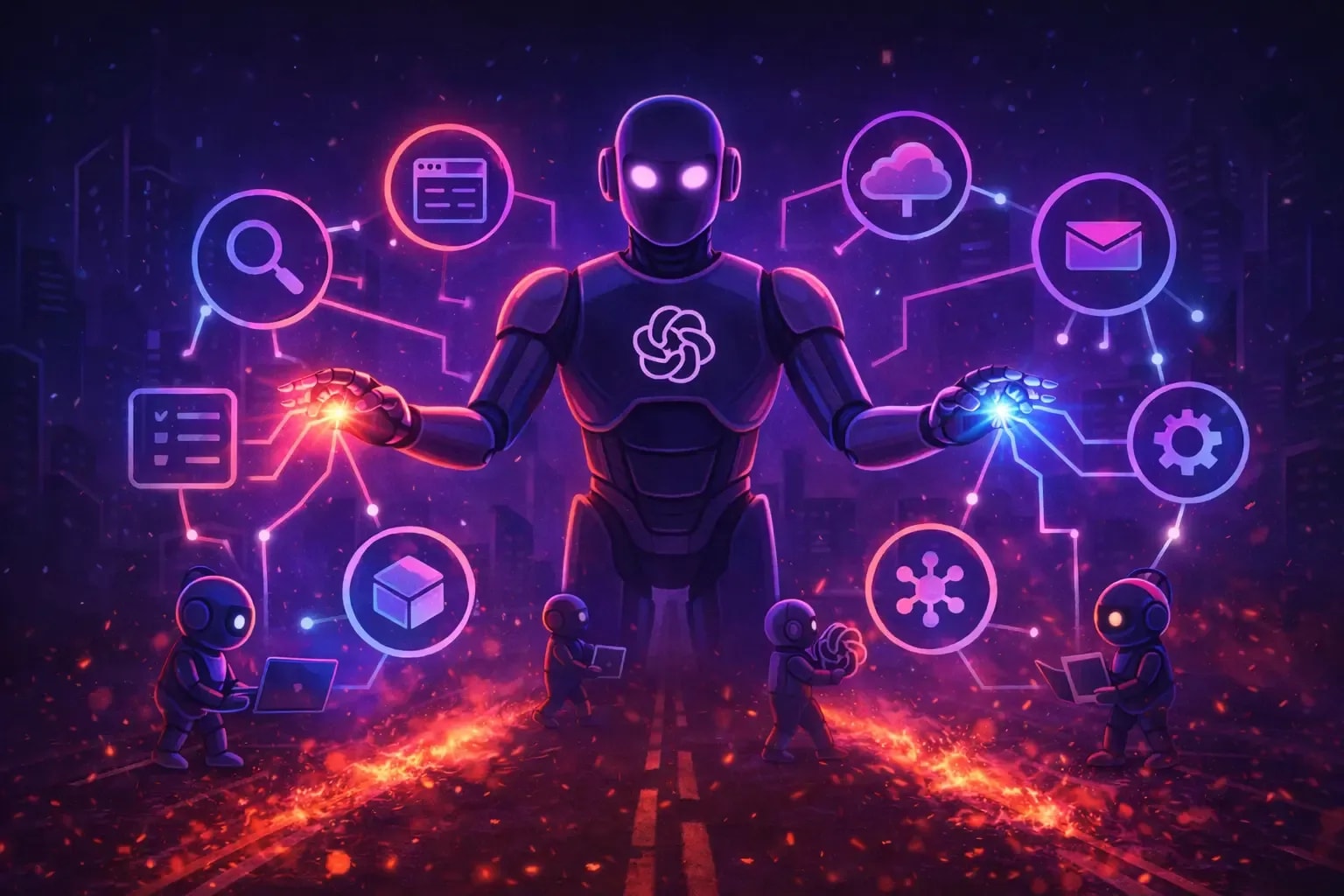
OpenAI just launched its Agentic Workflows API, part of the new AgentKit suite. This tool moves AI beyond simple chat into real, hands-on automation for business. It helps create agents that think, act, and handle complex tasks on their own. Think of it as a smart helper that runs workflows without constant human input.
What Makes AgentKit Different?
Earlier tools like GPTs were fun for consumers. The Assistants API let developers add tools to chats. But AgentKit goes further. It offers a visual builder to drag and drop workflows. You can version them, audit every step, and connect to business systems safely. Announced in October 2025 at Developer Day, it includes an Agent Builder, Connector Registry, and ChatKit modules.
How It Works Under the Hood
Agents use a “reason and act” loop, called ReAct. They pause to think: Do I need more data? Then they act by calling tools or APIs. For example:
- Scan an invoice, check it against orders, flag issues, and ask for human approval.
- Handle support tickets by analyzing sentiment, pulling customer history, and escalating if needed.
- Pull data from databases, create reports, and share insights instantly.
The Connector Registry links to internal tools or external APIs, all under strict security rules.
Why It Matters for Enterprises
In regulated fields like finance or healthcare, data privacy is key. AgentKit tackles this head-on:
- Admins control permissions so agents can’t touch sensitive data without approval.
- Every action is logged for audits, meeting rules like GDPR or HIPAA.
- OpenAI signs data agreements and guides on encryption.
The Competition
OpenAI isn’t alone. Anthropic focuses on safe, chat-based tools with strong guardrails. Google’s Vertex AI shines in scalable, multi-modal setups for Google users. Open-source options like LangGraph offer deep control for custom logic, while CrewAI handles teams of agents working together. OpenAI stands out with its easy visual tools, built-in observability, and enterprise governance.
Expert Views: Excitement Meets Reality
Andrej Karpathy, an AI leader, calls much of today’s agentic AI “slop.” He says true autonomy is years away – maybe a decade. Agents today are great helpers, not full replacements. They need human oversight for tough cases. Early adopters like Klarna see real gains in speed and efficiency, especially in controlled setups.
What This Means for Businesses
AgentKit makes automation accessible:
- Non-tech teams build workflows with no code.
- Deploy changes in days, not months.
- Security is baked in, reducing risks.
It opens doors to adaptive, auditable AI that fits existing systems.
Looking Ahead
Standards like the Model Context Protocol (MCP) could let agents work across vendors and clouds. Agentic AI isn’t just faster RPA – it’s proactive, accountable intelligence.
In short, OpenAI’s AgentKit brings practical, secure agentic workflows to enterprises. It’s a solid foundation for smarter operations, with humans still in the loop.
About @lowtouch.ai: Private, No-Code Agentic AI for Enterprises
At @lowtouch.ai, we build a no-code platform that turns your apps, APIs, and data into intelligent agents. It runs fully inside your infrastructure – on-premises or private cloud – so your data never leaves. No compromises on privacy or compliance.
We support the Model Context Protocol (MCP) for clean integrations. But we go beyond: agents call your existing APIs directly, no changes needed. Built-in connectors handle email, Jira, Confluence, ServiceNow, logs, and more. Mix MCP and direct calls for seamless fit with any system.
Our Core Stack
- ReAct and CodeAct for smart decision-making.
- Private LLMs like Nemotron 70B, Llama 3.1, Claude, or Gemini.
- Vector database for memory and context.
- Apache Airflow to orchestrate workflows.
- Observability with OpenSearch, Prometheus, and Grafana.
- HashiCorp Vault for secrets.
- Human-in-the-loop for approvals.
Agents deploy in 4-6 weeks. They reason, act, and learn autonomously while logging everything for transparency. We focus on business impact: faster ops, lower costs, happier teams.
Agentic AI is the future. @lowtouch.ai makes it secure, simple, and yours. Let’s talk about unleashing digital workers in your world.