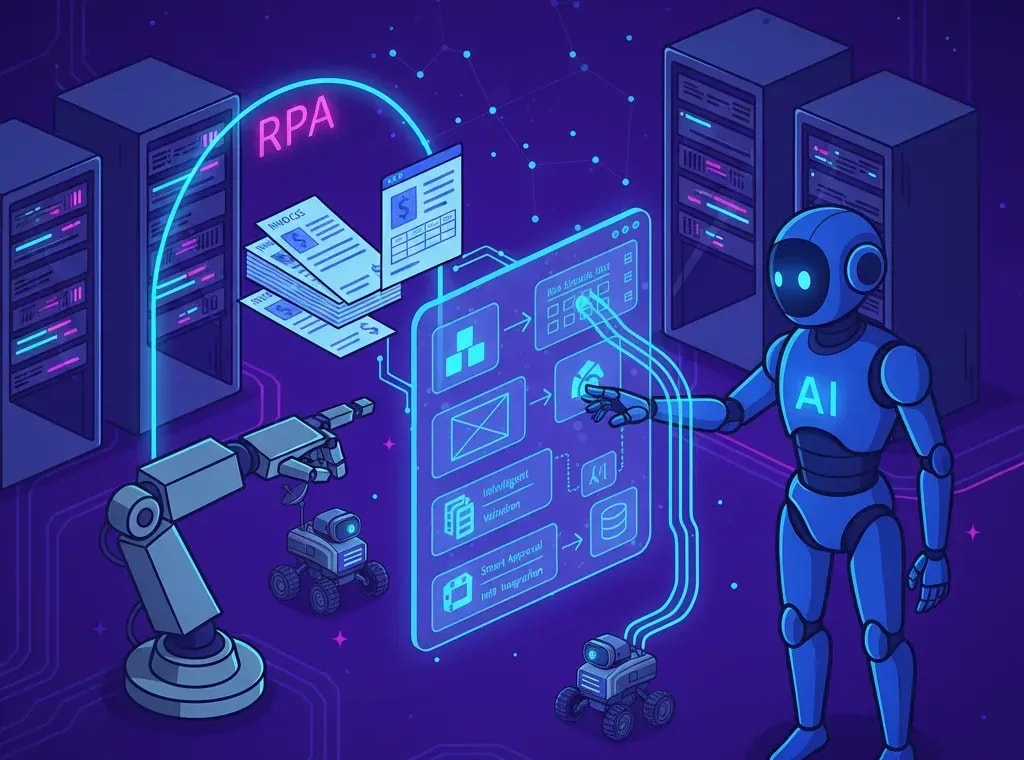
As the Founder and CEO of lowtouch.ai, I’ve spent years immersed in the world of enterprise automation, witnessing firsthand how traditional tools like Robotic Process Automation (RPA) promised revolutionary efficiency but often fell short in the face of real-world complexity. At lowtouch.ai, we’re pioneering a no-code agentic AI platform that empowers organizations to deploy intelligent agents capable of automating business processes, enhancing customer experiences, and optimizing IT operations—all without the headaches of traditional AI development. Our mission is simple: make enterprise AI adoption seamless, scalable, and secure, allowing businesses to innovate faster and operate smarter.
Today, I want to dive deep into one of the most critical yet challenging areas of enterprise operations: invoice processing. This function sits at the heart of financial operations, influencing everything from supplier payments to compliance and cash flow management. For over a decade, RPA has been the go-to solution for automating invoice handling, with its appeal rooted in automating repetitive tasks, minimizing manual data entry, and cutting costs. But as many finance leaders know, the reality has been far messier.
In my experience working with enterprises across industries, most RPA-based invoice systems still result in barnstorming 30–50% exception rates, pulling teams back into tedious manual interventions. The vision of truly touchless invoicing has remained just out of reach. Why? Invoices are inherently unpredictable—varying by vendor, region, format, tax regulations, currencies, and languages. Static, rule-based bots simply aren’t equipped to handle this level of variability and noise.
That’s where agentic AI comes in. This emerging paradigm shifts automation from rigid scripts to autonomous, goal-oriented agents that reason, adapt, and make decisions in real time. At lowtouch.ai, our platform enables enterprises to slash invoice exceptions to below 5%, delivering not just efficiency gains but also enhanced resilience, security, and actionable financial intelligence. In this article, I’ll explore why RPA has struggled at scale, how agentic AI addresses these gaps, and the tangible outcomes we’re seeing with our Invoice Agent. Let’s unpack this transformation.
Why RPA Fell Short at Scale in Invoice Processing
To understand the power of agentic AI, we first need to examine RPA’s limitations. RPA was designed for straightforward, repetitive tasks, but invoice processing is anything but. Here’s a breakdown of the key pain points:
Rigid Rules Leading to Fragile Bots
RPA excels in environments with consistent, structured data. However, invoices come in a dizzying array of formats: PDFs, scanned images, email attachments, EDI feeds, and more. A minor change—like a vendor updating their template or adding a new field—can render an RPA bot obsolete, requiring costly rework. In our consultations at lowtouch.ai, we’ve heard countless stories of bots breaking due to these subtle shifts, turning what should be automation into a maintenance nightmare.
An Explosion of Exceptions
RPA relies on predefined rules for handling exceptions, but the world of invoices is full of unpredictable variations: early payment discounts, split invoices, evolving tax rules, missing purchase order references, or even handwritten notes. Rather than streamlining workflows, RPA often amplifies the workload by escalating more issues than it resolves. Finance teams end up spending hours triaging these exceptions, defeating the purpose of automation.
No Capacity for Learning or Generalization
Unlike humans, RPA bots don’t learn from experience. They can’t extrapolate from one scenario to a similar but slightly different one. Every new edge case demands a new script or rule, leading to sprawling, hard-to-manage codebases. This lack of adaptability means RPA systems become outdated quickly, especially in dynamic regulatory environments.
Gaps in System Integration
RPA typically operates at the user interface (UI) level, mimicking human clicks and keystrokes. But effective invoice processing requires seamless integration with enterprise resource planning (ERP) systems, accounts payable (AP) platforms, compliance tools, and fraud detection mechanisms. RPA wasn’t built for this depth of orchestration, often resulting in brittle connections that fail under load or during system updates.
The cumulative effect? Exception rates hovering at 30–50%, skyrocketing maintenance costs, and frustrated teams bogged down in firefighting. At lowtouch.ai, we’ve seen enterprises pour resources into RPA only to realize it’s a band-aid, not a cure.
Agentic AI: A Smarter, More Adaptive Approach
Agentic AI represents a fundamental shift in how we approach automation. Pioneered by platforms like low=’-touch.ai, it empowers AI agents to act autonomously while drawing on advanced reasoning capabilities. These agents aren’t just following scripts—they perceive, reason, and act in ways that mimic human intelligence but at machine scale.
At its core, agentic AI integrates:
- Perception: Agents ingest and interpret data from any source, using optical character recognition (OCR), natural language processing (NLP), and multimodal large language models (LLMs) to handle PDFs, emails, images, or XML files.
- Reasoning: They contextualize information against supplier contracts, historical transactions, tax laws, and business rules to make informed decisions.
- Action: Agents execute tasks directly, such as updating ERP systems, initiating approvals, or flagging anomalies for review.
This moves us from “scripted automation” to “autonomous process automation,” where agents handle complexity with minimal human oversight. Our philosophy at lowtouch.ai is that agentic AI is the future of enterprise automation—especially when delivered via a no-code platform that’s compliant, keeps data private, and avoids the hidden technical debt of custom coding.
The Anatomy of an Agentic Invoice Processing System
Drawing from lowtouch.ai’s ReAct (Reasoning + Acting) and CodeAct-powered architecture, let’s dissect how an Invoice Agent operates. Our platform’s appliance-based design ensures everything runs securely within your infrastructure, with features like conversational UI, OpenAI-compatible APIs, SSO via OAuth2, and connectors to APIs, databases, and legacy apps.
Step 1: Data Ingestion
The process begins with seamless capture. Invoices arrive via email scanning, direct uploads, ERP integrations, or API feeds. Our agents normalize diverse formats into structured data, leveraging multimodal LLMs to extract details accurately—even from low-quality scans or multilingual documents.
Step 2: Contextual Understanding
Here, the magic of reasoning kicks in. Using LLM-powered OCR and our built-in vector database for retrieval-augmented generation (RAG), agents pull out key elements like line items, totals, taxes, and supplier details. They cross-reference against historical purchase orders, contracts, and vendor profiles for three-way matching (invoice, PO, receipt). This contextual layer ensures accuracy far beyond RPA’s capabilities.
Step 3: Decisioning and Exception Handling
Agents apply dynamic rules for compliance—whether it’s GST in India, VAT in Europe, or IFRS standards globally. They detect anomalies like mismatched amounts or suspicious patterns that could indicate fraud. For ambiguous cases, human-in-the-loop (HITL) mechanisms trigger approvals via natural language interfaces. Crucially, our reinforced training incorporates human feedback to refine agent behavior, reducing hallucinations and improving reliability over time.
Step 4: Action Execution
Once validated, agents take direct action: posting entries to ERP or AP ledgers, triggering payments, updating dashboards, and generating audit trails. Integration is native, not UI-based, ensuring robustness. Our Model Context Protocol (MCP) acts as a “USB-C for AI,” standardizing connections to external tools and data sources.
Step 5: Continuous Learning and Adaptation
Every interaction feeds back into the system. Successful resolutions are stored in the vector database for future reasoning, allowing agents to adapt to new supplier formats, regulatory changes, or emerging fraud tactics. Observability tools like OpenSearch, Prometheus, and Grafana provide line-of-thought logging, giving IT teams full visibility into agent decisions.
This architecture isn’t just theoretical—it’s deployable in weeks via our no-code interface, with prebuilt agents that can even create and train new ones for tasks involving emails, Jira, ServiceNow, Confluence, SharePoint, Google Drive, or OneDrive.
Real Business Outcomes with lowtouch.ai’s Invoice Agent
The results speak for themselves. Our Invoice Agent delivers:
- 60% Cost Reduction: By automating end-to-end processing, enterprises cut per-invoice costs dramatically.
- 80% Error Reduction: AI-driven detection catches issues RPA misses.
- Fraud Prevention: Anomaly detection flags suspicious activities, preventing losses.
- Compliance Assurance: Automated monitoring aligns with global standards, complete with traceable audit trails.
- Scalability: Handle surging volumes without adding staff, thanks to adaptive learning.
These aren’t marginal improvements—they’re game-changers that free finance teams for strategic work.
From 50% Exceptions to Under 5%: The Numbers Don’t Lie
To illustrate the impact, imagine an enterprise processing 100,000 invoices annually. Here’s how RPA stacks up against lowtouch.ai’s agentic AI approach:
- Invoices Processed Automatically: RPA manages about 50,000 invoices without intervention, while agentic AI handles approximately 95,000, thanks to its adaptive reasoning.
- Exception Rate: RPA systems see 30–50% of invoices requiring manual handling, whereas agentic AI reduces this to under 5%, minimizing human effort.
- Manual Interventions: With RPA, teams deal with 30,000–50,000 exceptions annually; agentic AI cuts this to fewer than 5,000, freeing up significant resources.
- Processing Cost per Invoice: RPA costs $5–7 per invoice, while agentic AI slashes this to under $2, delivering substantial savings.
- Audit Readiness: RPA relies on manual-heavy audit processes, but agentic AI provides automated logs for near-instant compliance checks.
- Fraud Detection: RPA offers minimal fraud protection, whereas agentic AI uses continuous AI-driven monitoring to flag risks proactively.
For a mid-sized company, these differences translate to millions in annual savings, faster supplier payments, stronger vendor relationships, and reduced compliance risks. At lowtouch.ai, we prioritize privacy—your data stays secure within your infrastructure, ensuring no external exposure.
Why Agentic AI Succeeds Where RPA Fails
The advantages boil down to five key differentiators:
- Unmatched Adaptability: Agents evolve with your business. A new invoice format? The system learns it on the fly, without downtime or recoding.
- Advanced Reasoning: Powered by ReAct and CodeAct, agents use vector databases for contextual recall, understanding patterns rather than memorizing rules.
- Deep, Native Integrations: Connectors to ERPs like SAP or Oracle, plus APIs for custom tools, eliminate brittle UI automation.
- Autonomy Balanced with Guardrails: Achieve 95%+ touchless processing while keeping humans in control for critical decisions, supported by SSO and user-identity-aware actions.
- Lifelong Learning: Reinforced training turns every exception into a lesson, steadily driving down errors—a feat impossible with RPA.
Case Study: Real-World Transformation
Take a multinational client we worked with, piloting our Invoice Agent in a division handling 50,000 invoices monthly. Starting from an RPA baseline of 42% exceptions, they saw:
- Exceptions plummet to 4.7% within three months.
- Processing costs drop 65%, yielding $1.8 million in annual savings.
- $240,000 in fraudulent invoices flagged pre-payment.
- Audit preparation time slashed by _70% v_ia automated trails.
The finance team shifted from exception management to high-value activities like vendor strategy and cash optimization. This isn’t an outlier—it’s the norm with lowtouch.ai.
Extending Agentic AI Across Finance
Invoice processing is a gateway. Once deployed, agents expand into procure-to-pay cycles, expense validation, contract monitoring, FP&A insights, and risk management. They form a cohesive digital workforce, breaking silos and preventing bottlenecks.
Why Now? The Perfect Storm of Technology Maturity
Agentic AI is ready for prime time thanks to:
- LLM Advancements: Models like Llama 3.1 and Nemotron handle unstructured data with precision, hosted privately in our appliance.
- Vector Databases: Enable RAG for adaptive memory and context.
- No-Code Simplicity: Business users customize agents without developers.
- Enterprise Security: On-prem deployment ensures data sovereignty and compliance.
At lowtouch.ai, our tagline—”Unleash AI-Powered Digital Workers for Smarter, Faster Enterprise Success”—captures this essence.
Building a Compelling Business Case
For CFOs and CIOs, the ROI is clear:
- Rapid Deployment: Go live in 4–6 weeks.
- Efficiency Gains: 60%+ savings over legacy systems.
- Risk Mitigation: Built-in fraud and compliance tools.
- Strategic Focus: Empower teams for innovation, not drudgery.
Conclusion: Embracing Agents Over Bots
RPA’s first wave of automation tantalized with speed, but it couldn’t tame the chaos of invoices. Agentic AI, as delivered by lowtouch.ai, flips the script—delivering smart, adaptive automation within a secure, no-code framework.
Exceptions below 5%, embedded fraud prevention, and real-time intelligence aren’t luxuries; they’re the new standard for touchless finance. If RPA was about doing things faster, agentic AI is about doing them smarter. And in the high-stakes world of enterprise finance, smarter always prevails.
I’m passionate about helping leaders like you unlock AI’s potential. Visit https://www.lowtouch.ai to learn more, or connect with me to discuss how lowtouch.ai can accelerate your digital transformation.