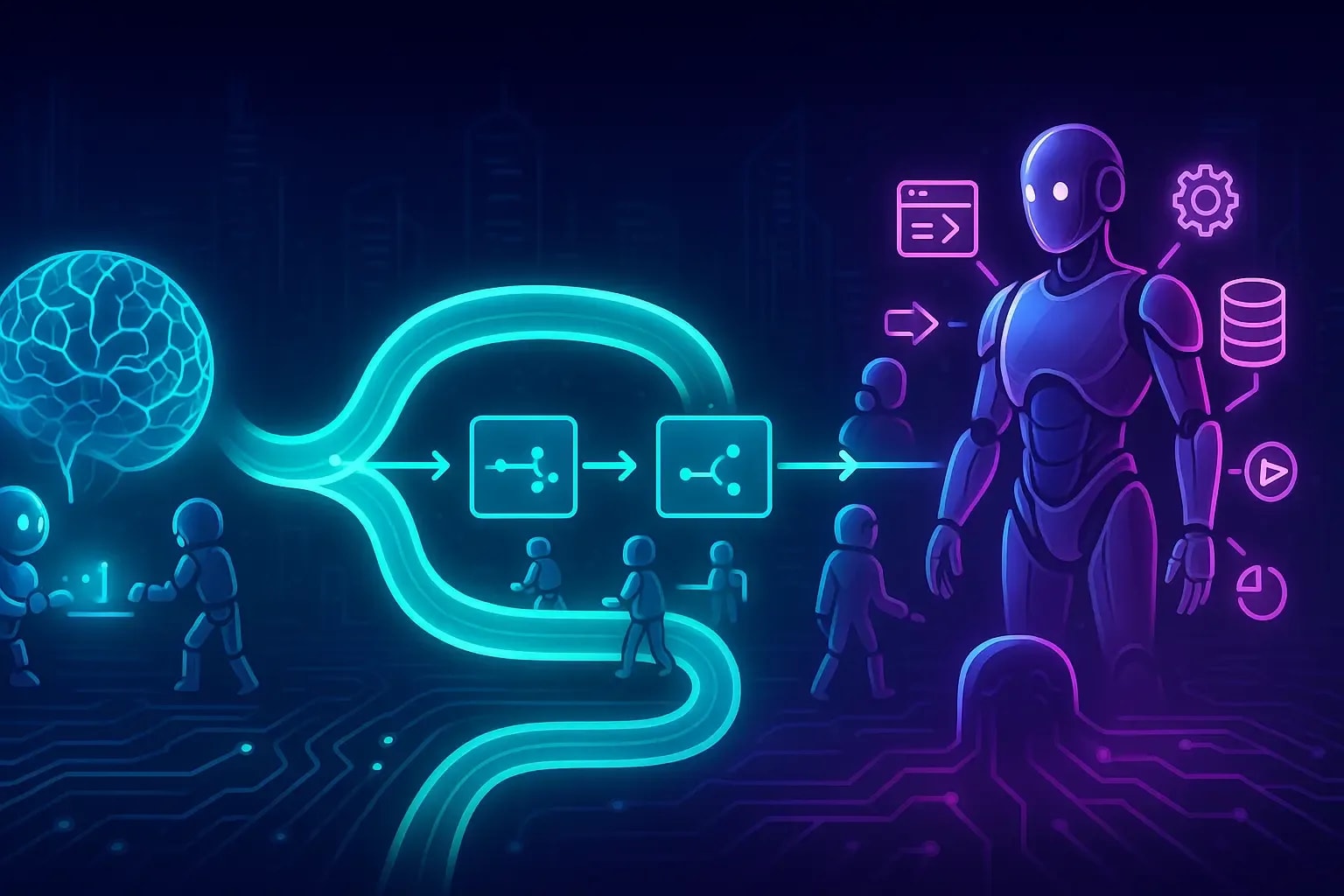
Flow engineering is a specialized discipline that designs and manages the complex, modular workflows needed for large-scale, agentic, and production-grade AI systems. Its evolution marks a shift from static workflow automation and manual prompt engineering towards systematic, scalable, and reliable orchestration of AI-powered tasks.
Definition and Evolution
Flow engineering focuses on structuring multi-step, modular interactions between components—agents, models, databases—using standardized message-passing and interfaces. This differs from traditional workflow or process engineering, which emphasized manual task automation or static rules for business processes. Modern flow engineering supports “System 2” AI reasoning, akin to deliberate human problem-solving, by breaking down tasks into iterative, testable steps, each with controlled inputs and outputs.
Application to AI Systems
Flow engineering is fundamental in orchestrating today’s advanced AI architectures, including LLM-based agents, multi-agent collaborations, event-driven systems, vector database integration, retrieval-augmented generation (RAG), logical grounding, monitoring, and feedback loops:
- Modular flows encapsulate atomic and composite tasks, isolating computation via actor-model inspired interfaces.
- Orchestrators (e.g., Prefect, Airflow, Dagster, Flyte) manage DAG-based execution, control data movement, and optimize resource allocation.
- Vector databases and retrieval layers are integrated in agent workflows, supporting semantic search, hybrid retrieval, and dynamic plan adjustment.
- Reliable feedback mechanisms—automated testing, iterative refinement—enhance error correction and solution robustness
Examples of Flow Architectures
- Agentic Platforms: OpenManus implements a “PlanningFlow” that creates step-wise plans, assigns executors, manages status transitions, and integrates vector DB queries and multi-agent cycles.
- Event-Driven Systems: Airflow and Dagster coordinate ETL, ML pipelines, event triggers, and dynamic branching for enterprise automation.
- Enterprise Tools: Workato, n8n, and Make provide visual flow platforms for integrating AI agents, APIs, and business logic via drag-and-drop orchestration.
Addressing Enterprise Production Needs
Flow engineering tackles key enterprise AI requirements:
- Reliability: Robust error handling, retry logic, state management, testing hooks, and clear failure modes.
- Latency: Optimized task scheduling, asynchronous execution, parallelization, and data pipelining.
- Scalability: Containerized execution environments, Kubernetes-native orchestration, multi-tenancy, auto-scaling.
- Observability: Real-time logging, visual dashboards (Grafana, Airflow UI), traceability of execution paths.
- Data Quality: Embedded validation, pre/post-commit checks, schema drift detection, feedback anchors.
Best Practices in Flow-Based AI Pipelines
- Map work as it actually flows—including team handoffs, tools, and bottlenecks.
- Prototype and refine using AI-powered automation for constraint removal.
- Align cross-functional stakeholders around outcomes, not just tasks.
- Use modular, versioned flows with automated branch-per-run isolation for data pipelines.
- Integrate automated data validation and centralized metadata management.
- Continuous experimentation and iterative design for workflow optimization.
Key Tools, Frameworks, and Platforms
| Platform/Tool |
Notable Features |
Use Case |
| Airflow |
DAG-based, customizable orchestration |
ML/ETL pipeline management |
| Dagster |
Data-centric, validation-first |
Data pipeline reliability |
| Prefect |
Agent + Flow architecture, observability |
AI workflow automation |
| Airbyte |
— |
— |
| Flyte |
Kubernetes-native, multitenancy |
Scalable ML operations |
| Monte Carlo Data |
— |
— |
| Workato/n8n |
Visual workflow for integration |
Enterprise automation |
| LangChain |
Specialized LLM flow integration |
Model orchestration, RAG |
| AlphaCodium |
Iterative test-driven code generation |
LLM-based code workflows |
| LeewayHertz |
— |
— |
Enterprise Benefits: Operational Load, Deployment Cycle, Business Outcomes
- Reduces manual effort and operational load by automating and modularizing workflows.
- Accelerates deployment cycles through rapid prototyping, branch isolation, and automated testing.
- Improves business outcomes by optimizing resource usage, increasing reliability, and enabling real-time adaptation to changing business needs.
Comparison Table: Flow Engineering vs. Workflow Automation, MLOps, RPA
| Feature |
Flow Engineering |
Workflow Automation |
MLOps |
Traditional RPA |
| Modularity |
High (atomic/composite) |
Medium |
Medium |
Low |
| Scalability |
Native, multi-tenant |
Limited |
Native |
Limited |
| Model Orchestration |
Yes (agents, LLMs, tools) |
No |
Yes (model-centric) |
No |
| Feedback Loops |
Iterative, automated |
Basic/manual |
Continuous via retraining |
None/manual |
| Observability |
Rich, real-time |
Basic logs |
Monitoring/alerting |
Logs/screenshots |
| Data Quality |
Embedded tests/hooks |
Dependent on config |
Validation, drift checks |
None |
| Adaptability |
Dynamic/pluggable |
Rigid/static |
Moderate |
Rigid |
Diagram: Flow Engineering Architecture
Research and Trends
Current research emphasizes modular pipeline design, robust orchestration, feedback-driven optimization, and integration of LLM agents with data-centric flows. Frameworks such as LangChain, AlphaCodium, and OpenManus showcase advanced flow architectures for code generation, multi-agent collaboration, and real-time automation in enterprise settings.