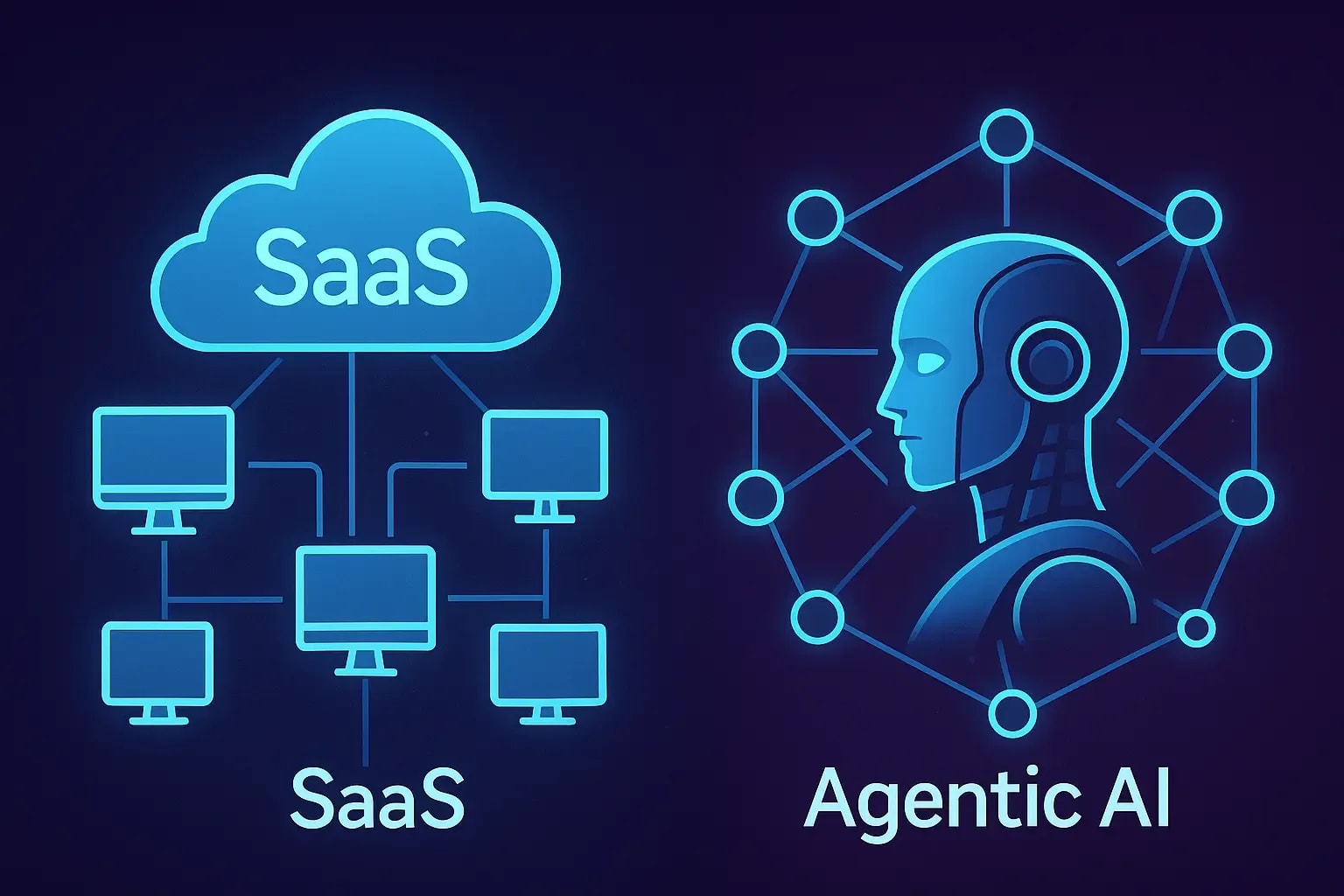
From SaaS to Agentic AI: The Next Frontier of Enterprise Software
The integration of generative AI into SaaS solutions is accelerating at a record pace. According to industry projections, global AI software revenue is expected to reach $118.6 billion by 2025, up from just $9.5 billion in 2018. With nearly every new software product predicted to include AI capabilities by 2025, the software landscape is undergoing a radical transformation.
SaaS Today: Progress with Problems
SaaS has long been hailed as a breakthrough—offering scalable, cloud-based alternatives to clunky on-premise solutions. It unlocked flexibility, reduced infrastructure overhead, and made software accessible to businesses of all sizes. But as we move deeper into the 2020s, cracks are beginning to show:
- Tool Bloat: Businesses use dozens of SaaS tools. A 2022 survey found 42 % of IT pros struggle to identify unused licenses, with 20–39 % of spending wasted.
- Data Silos: Separate platforms create duplicate records, inconsistent metrics, and workflow friction.
- Coordination Overhead: Knowledge workers spend 12 hours per week “chasing data,” per Forrester.
While vendors add generative AI co-pilots and chatbots, the underlying fragmentation remains—and humans still orchestrate across disconnected tools.
Enter Agentic AI: The Next Generation of Enterprise Software
Agentic AI doesn’t just support workflows—it autonomously executes them end to end. Unlike traditional AI that assists isolated tasks, agentic AI refers to autonomous software agents that can reason, plan, adapt, and improve over time.
What Can Agentic AI Do That SaaS Can’t?
Consider HR onboarding:
- Typical SaaS setup: ATS + HRMS + communication tool + task manager, with manual handoffs.
- Agentic AI:
- Retrieves candidate data
- Sets up system access
- Schedules introductions
- Monitors the journey
- Learns and refines the process autonomously
This replaces coordination work—one of the biggest enterprise bottlenecks.
Why SaaS Alone May Not Be Enough
The future won’t be a SaaS vs. AI binary. Coexistence will define the landscape, but the center of gravity is shifting.
Klarna’s pivot away from vendors like Salesforce and Workday toward AI agents illustrates how enterprises are rethinking tool fragmentation.
The Rise of Non-Human Customers
Here’s the twist: your next “customer” may be an AI agent—buying services, coordinating suppliers, or negotiating contracts autonomously. This reframes software from a product to a digital labor force: service-as-software.
CMOs: How to Prepare for the Age of Agentic AI
To thrive, marketing leaders must:
- Build Customer Trust: Agents favor brands with clean preferences and permissions.
- Expose Structured Data & APIs: Ensure your systems are machine-readable and well-tagged.
- Run Outcome-Based Campaigns: Focus on actions, not just impressions—agents optimize for results.
Final Thoughts: A Future of Coexistence, Not Collapse
Technological revolutions restructure rather than replace. PCs didn’t vanish with mobile; humans were augmented by AI, not replaced.
Agentic AI is not the death of SaaS—it’s its evolution. The winners will be those who blend legacy tools and autonomous agents into a unified, adaptive enterprise.