The rapid integration of Artificial Intelligence (AI) into software development has birthed a new paradigm — one that frequently leaves developers questioning the enduring value of their hard-earned skills. As tools like Claude Code and various AI-driven development agents enter the mainstream, a pervasive narrative has emerged: the old rules of programming must be discarded to make way for the new. However, this assumption is fundamentally flawed. In the new era of generative AI, software fundamentals matter more now than they ever have before. Rather than rendering veteran developers obsolete, AI amplifies the necessity of rigorous software design, strategic thinking, and established engineering principles.
The Myth of "Specs to Code" and Cheap Code
A prominent trend that has surfaced alongside AI coding assistants is the "specs to code" movement. The underlying philosophy suggests a hands-off approach: developers simply write a specification detailing how an application should function, feed it to an AI, and let the machine translate it into a codebase. If the resulting application possesses bugs or fails to meet requirements, the developer is instructed to completely avoid looking at the actual code. Instead, they return to the original English specification, tweak it, and run the AI "compiler" again to output fresh code.
In practice, however, this iterative process often leads to disastrous results. Running the AI generation repeatedly without inspecting or maintaining the underlying code does not refine the application — it degrades it. The code produced becomes progressively worse, ultimately devolving into unusable garbage. This hands-off approach is merely vibe coding by another name, fundamentally failing to recognize how software systems naturally evolve.
The fatal flaw in the "specs to code" philosophy is its reliance on the assumption that "code is cheap." This is a dangerous misconception. Code is not cheap; in fact, bad code is currently the most expensive it has ever been. To understand why, one must look at the concept of "software entropy" — a principle outlined in the classic engineering book The Pragmatic Programmer. Software entropy dictates that without active, holistic design management, systems naturally tend toward disaster, drifting apart and structural collapse. When a developer or an AI makes a change focusing solely on immediate functionality rather than the overall system design, the codebase continuously deteriorates.
Furthermore, John Ousterhout's A Philosophy of Software Design defines bad code as "complex code." Complexity involves any structural element that makes a software system difficult to understand and modify. A bad codebase is fundamentally one that is hard to change without causing new bugs. Conversely, good codebases are easy to change. If your codebase is rigid and complex, you are actively blocked from reaping the immense bounties that AI can offer, because AI tools only truly excel when operating within a well-structured codebase. Therefore, good codebases — and the traditional software fundamentals required to build them — are the ultimate bottleneck for AI leverage.
Failure Mode 1: The Misaligned AI and the Missing Design Concept
One of the most common frustrations developers face when working with AI is severe misalignment: you have a clear idea in your head, but the AI produces something entirely different or unwanted. This friction stems from a profound communication barrier between the human and the machine. According to The Pragmatic Programmer, "no one knows exactly what they want" immediately, making the prompt-to-code conversation a form of raw requirements gathering where the AI tries to extract what you actually need.
Frederick P. Brooks, in his foundational book The Design of Design, introduces a concept that perfectly diagnoses this issue: "the design concept." When multiple entities — whether human developers or a human and an AI — collaborate on a build, there is an invisible, ephemeral theory floating between them regarding what is being created. This design concept is not a tangible asset, and it is not something you can just throw into a markdown file; it is the shared mental model of the build. When an AI generates the wrong output, it is because you and the AI do not share a synchronized design concept.
To solve this, developers must avoid the temptation to let AI agents rush into their default "plan mode." Tools like Claude Code are incredibly eager to just create an asset and start working. Instead, developers should employ a deliberate skill often called the Grill Me technique. This involves instructing the AI to act as an adversary, relentlessly interviewing you about every aspect of the plan until a shared understanding is truly reached. The prompt should command the AI to "walk down each branch of the design tree," resolving dependencies and decisions one by one.
This specific technique has proven wildly successful — a GitHub repository containing this skill gathered over 13,000 stars because it fundamentally transforms the planning phase. By forcing the AI to ask 40, 60, or even 100 clarifying questions, you synchronize the invisible design concept before a single line of code is written. This comprehensive conversation can then be distilled into a highly accurate Product Requirements Document (PRD) or turned directly into actionable issues for an AFK (away from keyboard) agent to execute.
Failure Mode 2: The Verbose AI and Ubiquitous Language
Even when the AI has a general idea of the goal, developers often find that the AI is overly verbose or seems to be talking at cross-purposes, using too many words to communicate what it is doing. The interaction feels disjointed because you are not using the same language. This scenario closely mirrors the traditional challenge of developers communicating with non-technical domain experts — the lack of shared terminology guarantees mistranslation.
The solution to this language gap lies in Domain-Driven Design (DDD). A core tenet of DDD is the creation of a ubiquitous language. A ubiquitous language ensures that conversations between developers, expressions within the codebase itself, and discussions with domain experts are all derived from a singular, unified domain model.
In the context of AI coding, developers can utilize a "ubiquitous language skill." This involves scanning your existing codebase for terminology and automatically generating a central markdown file containing tables of these core terms. By passing this markdown file to the AI and keeping it open during planning sessions, you force both yourself and the LLM to use the exact same vocabulary constantly. Reading the AI's internal thinking traces reveals that this shared language drastically reduces its verbosity, sharpens its planning capabilities, and ensures the ultimate implementation aligns perfectly with what was actually planned.
Failure Mode 3: Outrunning the Headlights
Imagine that you and the AI are perfectly aligned, utilizing a ubiquitous language, and the AI knows exactly what to build. Yet the code it produces simply does not work. In traditional development, ensuring functionality requires robust feedback loops: utilizing static typing like TypeScript, granting the LLM access to the browser so it can visually inspect its output, and maintaining automated tests.
However, even when these feedback loops are available, AI agents notoriously fail to utilize them effectively on their own. Left to its own devices, an LLM will attempt to do entirely too much at once. It will write massive amounts of code before it even considers running a type checker or executing a test suite. The Pragmatic Programmer describes this dangerous behavior as "outrunning your headlights" — driving too fast for your vision to keep up. In software engineering, your rate of feedback is your ultimate speed limit.
Because the AI naturally struggles to take small, deliberate steps, developers must enforce strict speed limits using Test-Driven Development (TDD). TDD forces the LLM to slow down and act methodically. By dictating that the AI must create a test first, make that single test pass, and only then refactor the code to improve its design, you constrain the AI's erratic pacing.
Failure Mode 4: Testing Friction and the Imperative of Deep Modules
Implementing TDD with AI introduces its own profound challenge: writing good tests has always been inherently difficult. Testing requires navigating a web of interconnected decisions — determining the size of the unit to test, identifying what external components must be mocked, and deciding which specific behaviors actually warrant validation. Testing massive, intertwined applications often results in flaky, unreliable test suites.
This brings us right back to the core premise that fundamental code quality is paramount. Good codebases are fundamentally easy codebases to test, which in turn creates better feedback loops for the LLM, ultimately allowing it to produce better code. To achieve a testable architecture that an AI can easily explore and understand, developers must structure their code into deep modules — a critical concept championed by John Ousterhout.
Many modern codebases are littered with "shallow modules" — tiny, fragmented blobs of code that expose complex interfaces but hide very little actual functionality. AI generation naturally tends to create codebases filled with these shallow modules. When an AI attempts to explore a repository built this way, it quickly becomes lost. It fails to navigate the complex web of tiny dependencies, struggles to find the correct module in time, and ultimately fails to comprehend what your code actually does.
Conversely, a codebase built with deep modules hides vast amounts of internal functionality behind a highly simplified interface, completely masking the internal complexity of the system. Developers can utilize an "Improve codebase architecture" skill to actively explore their repository, identify clusters of related code, and carefully wrap them inside a deep module boundary. While quite complicated to achieve, this architectural refactoring yields a highly testable codebase because the boundaries are stark and simple. You only need to write tests against the clean interface, verifying the functionality without needing to test the tangled internal implementations. A codebase structured this way actively rewards Test-Driven Development.
Failure Mode 5: Cognitive Exhaustion and Strategic Delegation
The final failure mode of the AI era is intensely personal: profound cognitive exhaustion. When your feedback loops are optimized and the AI is churning out more code than you have ever shipped before, developers often find their brains simply cannot keep up. Reviewing and maintaining a holistic understanding of every massive code block generated by an LLM is exhausting. If your codebase requires you and the AI to hold all of its complex information in your working memory simultaneously, you will inevitably burn out.
This is where the power of deep modules transcends pure technical architecture and becomes a tool for cognitive preservation. By structuring your application with deep modules, you can treat large sections of your codebase as "gray boxes." The most sustainable workflow in the AI era is to meticulously design the interface, but delegate the implementation.
For many non-critical sections of your application (excluding highly sensitive areas like finance), you can focus your mental energy solely on designing the simple outer boundary of the module and understanding its purpose. You do not need to obsess over reviewing the internal implementation details. You can mentally offload the work by saying, "AI, I will let you handle what is inside the big blob; I am just going to design the interface from the outside and verify it." This separation of concerns genuinely saves your brain from overwhelming fatigue.
The Strategic Engineer
This highly leveraged, delegated workflow requires a constant, vigilant awareness of your system's architecture. Every time you touch the code or plan new features, you must know your application's map of modules intimately. It must be integrated into your ubiquitous language, and your planning PRDs must be highly specific about how module interfaces are being modified. As software visionary Kent Beck advises, you must "invest in the design of the system every day."
The "specs to code" movement is a dangerous divestment from system design. Getting rid of design oversight ensures failure. Instead, by treating AI as a highly capable, tactical "sergeant on the ground" making raw code changes, you elevate your own role. You must become the strategic commander, thinking and planning at the highest level of your system's architecture.
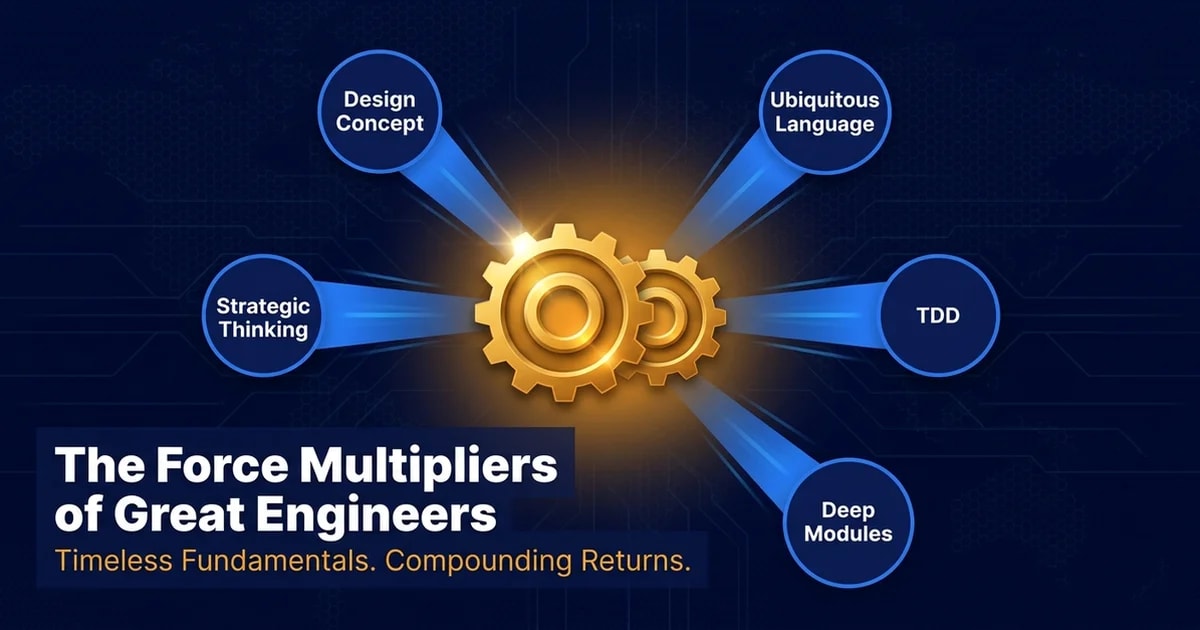
Occupying this strategic level requires the exact same software fundamental skills that veteran engineers have been refining for twenty years or longer. Code is deeply important, and it is the essential foundation upon which true AI leverage is built. By rejecting shortcuts and embracing foundational principles — shared design concepts, ubiquitous languages, TDD, and deep module architecture — developers can navigate the age of AI with the supreme confidence necessary to make a massive impact.