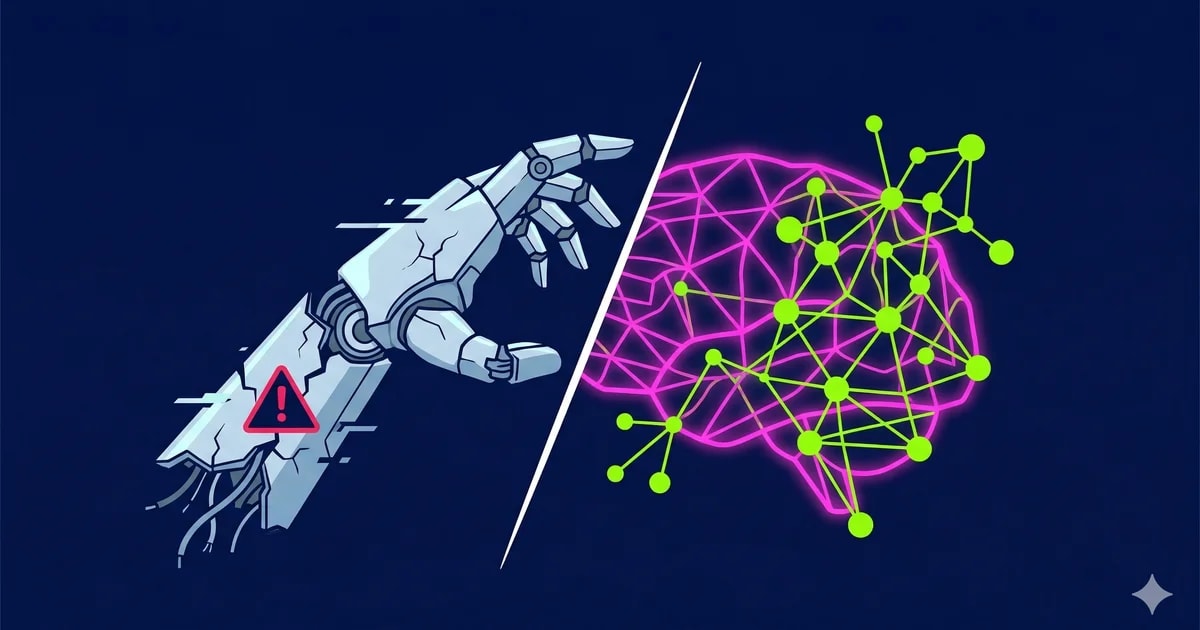
Between 30 and 50 percent of enterprise RPA projects are abandoned within two years, according to research from Gartner and Forrester. That's not an implementation problem — it's an architectural one. The debate around agentic AI vs robotic process automation is no longer academic: RPA was built for a world of stable, structured, rule-bound processes, and that world doesn't exist at scale in modern enterprises. RPA bots break when inputs change, require constant maintenance as upstream systems evolve, and simply cannot reason their way through ambiguity. They were never designed to.
The question CTOs are asking in 2026 is not whether to replace RPA. That decision, for most organizations running mature automation programs, is already made. The real question is how fast to migrate, which processes to prioritize, and what the transition actually looks like operationally. AI agents — systems that observe context, reason about goals, and act across dynamic workflows — solve the structural failures that RPA never could. This post breaks down exactly why RPA fails at the architectural level, what agentic AI does differently, and how to execute a migration that doesn't blow up your existing operations in the process.
Why RPA Was Always a Brittle Bet
RPA's structural problems fall into three categories: it cannot handle change, it cannot handle ambiguity, and the cost of keeping it functional never stops growing.
1. Rule Rigidity
- Scripted against fixed UI states: RPA bots execute a predetermined sequence of steps against specific screen coordinates, field names, and button positions. The automation knows exactly where to click — until it doesn't.
- One layout change breaks everything: When a vendor updates their portal, a field is renamed in an ERP upgrade, or a button shifts two pixels left in a UI refresh, the bot fails. Not gracefully — it fails silently or throws an error that requires human intervention to diagnose.
- Maintenance backlogs compound fast: Each broken bot generates a developer ticket. In enterprises running dozens or hundreds of bots across multiple upstream systems, these tickets accumulate faster than teams can resolve them.
- The ROI math inverts: Industry research, including analysis from Everest Group, consistently shows enterprises spending 30–40% of their RPA budget on maintenance rather than building new automation. The platform that was supposed to free up engineering capacity ends up consuming it.
2. Zero Reasoning on Unstructured Data
- Structured input is a prerequisite, not a feature: RPA requires data to arrive in a consistent, predictable format. It can read a fixed-column CSV. It cannot read a PDF invoice where the vendor places the total amount in a different location every time.
- The enterprise data reality: Eighty percent of enterprise data is unstructured — emails, PDFs, scanned documents, images, and free-text fields — according to IDC research. RPA is architecturally incapable of processing the majority of the data that flows through modern business operations.
- Configuration cannot fix a design constraint: Teams attempt to work around this with OCR layers, template matching, and preprocessing pipelines. These add cost and fragility without solving the underlying problem. When the document format changes, the workaround breaks alongside the bot.
- Exceptions become the rule: In practice, any RPA workflow touching unstructured data generates a high rate of exceptions that route back to human queues — which is exactly the outcome automation was meant to eliminate.
3. The Maintenance Tax
- Every process change is a development event: Business processes evolve continuously. New compliance requirements, vendor switches, system upgrades, and policy changes all require a developer to rewrite or reconfigure the affected bots. There is no self-correction, no adaptation — only rewrites.
- Linear scaling, not intelligent scaling: Adding more automation with RPA means adding more bots, more maintenance overhead, and more specialist headcount to manage the bot estate. The system scales linearly with engineering effort, not with the intelligence of the platform.
- The "automate once, run forever" promise fails empirically: The original value proposition of RPA — build it once and capture ongoing savings indefinitely — almost never materialises in practice. Bots require continuous intervention to stay functional as the environments they operate in change around them.
- Graveyard bots are the norm: Most enterprises running RPA at scale end up with a significant percentage of their bot inventory either broken, deprecated, or running at degraded accuracy within three years of initial deployment. The total cost of ownership far exceeds what was projected at the point of purchase.
What AI Agents Do That RPA Can't
Each of the three structural failures above has a direct architectural answer in agentic AI. These are not incremental improvements — they reflect a fundamentally different approach to automation.
1. Adaptive, Not Scripted
- Goal-directed reasoning replaces fixed sequences: RPA bots follow a script. AI agents reason about the objective. When the task is "process this vendor invoice and update the ERP record," the agent determines the steps dynamically rather than executing a hardcoded path through specific UI elements.
- Change is handled, not broken by: When a form layout shifts, a vendor updates their portal, or a data format changes upstream, the agent adapts its approach without requiring a developer to rewrite anything. The goal stays constant; the path to it flexes.
- Operations teams own it — not engineering: lowtouch.ai's no-code agent builder means the people who understand the process can adjust agent behaviour directly when something changes. There is no ticket queue, no sprint, no waiting for a bot specialist to unblock a business workflow.
2. Handles Unstructured Data Natively
- LLMs are the parsing layer: Agents use large language models to read, extract, and reason over PDFs, emails, scanned images, and free-text documents — the same formats that cause RPA to fail or route to a human exception queue.
- Format variance is a non-issue: A vendor invoice where the total appears in a different location every time, a contract PDF with embedded tables, an email with approval instructions buried in the third paragraph — agents process all of these correctly without preprocessing pipelines or template matching.
- Sensitive data stays on your infrastructure: For regulated industries — financial services, healthcare, insurance — data residency is not optional. lowtouch.ai's private and on-premises deployment options mean sensitive financial documents and customer data never leave your infrastructure. This is a direct operational requirement that cloud-only automation platforms cannot meet.
3. Self-Correcting, Human-in-the-Loop by Design
- Agents know what they don't know: When a genuine edge case falls outside the agent's confidence threshold, it escalates to a human — with full context pre-populated, the relevant documents surfaced, and the decision clearly framed. The human resolves the exception and the agent learns from the outcome.
- Process changes take minutes, not sprints: Updating agent behaviour is configuration, not code. A new compliance rule, a changed vendor format, a revised approval threshold — these are adjustments, not development projects.
- Consolidation at scale: One well-designed agent can replace five to ten RPA bots that were each handling a narrow variant of the same underlying workflow. The bot estate shrinks; coverage expands.
That consolidation dynamic is part of why enterprise interest in agentic systems has moved so fast. Gartner tracked a 1,445% surge in enterprise inquiries about multi-agent systems between Q1 2024 and Q2 2025 — that's not a trend, that's a migration. The organizations asking those questions are not evaluating AI agents as a future investment. They are actively replacing RPA deployments that have become too expensive to maintain and too rigid to extend.
The Invoice Processing Test: AI Agents vs RPA
Accounts payable automation is one of the most common RPA use cases in enterprise finance operations — and one of the most instructive places to observe where the architectural difference actually matters. The workflow is straightforward in theory: receive a vendor invoice as a PDF, extract line items and totals, validate them against the corresponding purchase order, then route the invoice for approval or flag it as an exception. Run this test side by side with an RPA bot and an AI agent and the gap becomes concrete fast.
The RPA Approach
- Requires the incoming PDF to match a specific template — if a vendor's invoice layout differs from the format the bot was trained on, extraction fails or produces incorrect output
- Typically includes 3–5 hardcoded exception handlers for known failure modes, such as missing PO numbers or totals that don't reconcile — anything outside those handlers routes to a human queue with no context
- Breaks completely when any vendor changes their invoice layout, even minor reformatting — restoring function requires a developer to remap the extraction logic
- New vendor onboarding requires manual reconfiguration by a developer before the first invoice from that vendor can be processed automatically
- In practice, accuracy on non-standard formats can drop to around 40% — making the automation actively unreliable for a significant share of real-world invoice volume
The AI Agent Approach
- Reads any PDF invoice regardless of format — structured invoices with fixed fields, semi-structured documents with variable layouts, and free-form text invoices all process through the same agent without preprocessing
- Reasons about ambiguous line items contextually — for example, determining whether "service fee" and "professional services consulting" refer to the same PO line item based on vendor history, contract terms, and surrounding document context
- Routes genuine exceptions to a human reviewer with the relevant invoice, PO, and discrepancy summary pre-populated — no data re-entry required, and the reviewer acts on a framed decision rather than raw documents
- New vendor onboarding requires zero developer involvement — the agent reads the first invoice from an unfamiliar vendor and processes it the same way it handles every other format
- Typical results show 95%+ accuracy across formats, including variant and non-standard layouts that would cause an RPA bot to fail or route to exception
| Dimension |
RPA Bot |
AI Agent |
| Setup time |
4–8 weeks |
1–2 weeks |
| Handles non-standard formats |
No |
Yes |
| Exception handling |
Hardcoded rules |
Contextual reasoning |
| Maintenance when process changes |
Developer ticket |
Configuration change |
| Accuracy (standard formats) |
~85% |
~95% |
| Accuracy (variant formats) |
~40% |
~95% |
| New vendor onboarding |
Manual reconfiguration |
Automatic |
| Cost over 3 years |
Increases (maintenance) |
Decreases (scale) |
For a deeper workflow walkthrough of this exact use case, see How Agentic AI Transforms Invoice Processing.
When to Pull the Plug on Your RPA
Some RPA is still fine. If you have a rule-perfect, static, fully structured process with near-zero exceptions and no upstream system changes on the horizon, leave it alone. But if three or more of the following signals apply to your environment, migration is overdue.
Maintenance tickets for bot failures exceed new automation requests — When your team spends more time keeping existing bots alive than building new automation, RPA has become a liability, not an asset.
Less than 60% of your bots run without human intervention each week — A bot that requires regular human babysitting has eliminated its own value proposition. If automation needs constant supervision to function, it has not automated the work — it has redistributed it.
Any business process change requires a developer sprint to update bots — If your automation roadmap is blocked by developer capacity, you have built a dependency, not a solution. Every vendor switch or system upgrade becomes a development event rather than a configuration adjustment.
You have a "bot graveyard" — automations abandoned after breaking — Most enterprises running RPA at scale have them. A graveyard is evidence that the cost of maintaining RPA eventually exceeds the benefit. Each abandoned bot represents a process running manually while the broken automation sits undecommissioned.
Your team spends more time debugging RPA than the time the automation saves — When the math inverts, there is no longer a case to maintain the status quo. If engineers diagnosing bot failures consume more hours than the bots save, the program is net-negative.
The diagnostic is not about whether RPA ever worked. For many organizations it did, in the early years against stable, structured processes. The question is whether it still works at the scale and complexity of your current operations — and whether the team maintaining it is building toward the future or managing the past.
How to Replace RPA with AI Agents Without Burning Everything Down
Migration does not mean ripping everything out at once. A phased approach protects existing operations, builds an internal business case from real pilot data, and lets the team develop muscle memory with agentic tooling before committing to portfolio-wide replacement.
Phase 1 — Audit (Week 1–2)
Catalogue all active RPA bots. For each one, score it on four dimensions: failure frequency (how often does it require human intervention or generate an error ticket), maintenance cost (developer hours consumed in the last 90 days), business criticality (what breaks if this bot goes down), and data type (structured input only, or does it touch unstructured data like PDFs and emails). Flag the top 20% by maintenance burden as Priority 1 migration candidates — these are the bots already failing on their own terms, and replacing them is the fastest path to measurable cost reduction.
Phase 2 — Identify AI-Ready Candidates (Week 2–3)
Not every bot in your Priority 1 list is equally suited for AI agent migration. The best candidates share a few characteristics: high unstructured data volume (PDFs, emails, scanned documents), frequent exception rates that are already routing to human queues, and multi-vendor inputs where format variance is the norm. The worst candidates for migration are the opposite: stable, fully structured, rules-based processes with near-zero exceptions and no upstream system volatility. Keep RPA running for these — they are doing exactly what RPA was designed to do. The output of this phase is a ranked migration list, ordered by the combination of migration readiness and reduction in maintenance cost.
Phase 3 — Pilot One Workflow (Week 3–6)
Pick the highest-ROI candidate from Phase 2 and run a controlled pilot. Deploy the AI agent alongside the existing RPA bot in parallel — both processing the same inputs — so you can directly measure performance without disrupting live operations. Track four metrics: accuracy rate, exception frequency, processing time, and developer intervention required. Run the parallel deployment for two to four weeks until you have a statistically meaningful sample. Use the pilot results to build the internal business case for full migration. Quantified data from a live workflow is far more persuasive to a finance or operations stakeholder than vendor benchmarks.
Phase 4 — Scale (Month 2+)
Replace bots in priority order using the lessons from the pilot. Each migration follows the same pattern: deploy the agent in parallel, validate in production, decommission the RPA bot only after the agent has met your accuracy and reliability thresholds. Track three portfolio-level metrics as you scale: total maintenance tickets across the bot estate (should decline), bot failure rate (should decline), and processing accuracy across all automated workflows (should increase). The compounding effect of reduced maintenance overhead is measurable within the first quarter of active migration — and it accelerates as the highest-burden bots are replaced first.
If between 30 and 50 percent of RPA projects are abandoned, that is not a vendor failure — it is an architectural verdict. The organizations that built on RPA were not wrong to automate; they were working with the best available tooling at the time. That tooling has been superseded. The enterprises moving fastest in 2026 stopped maintaining bots and started building agents. They are running pilots, decommissioning their worst-performing bots, and compounding the savings quarter over quarter. The gap between those organisations and the ones still managing bot graveyards is widening.
If you're ready to see what this looks like for your specific workflows, visit lowtouch.ai and schedule a demo. We'll show you how to migrate your first workflow in under two weeks.