The Headline Says RPA Is Dead. The Market Says Otherwise. Both Are Right.
UiPath just posted $481.1 million in Q4 FY2026 revenue, a 13.4% year-over-year increase, alongside a $500 million stock buyback and a $2 billion ARR target for FY27. Automation Anywhere reported the largest non-GAAP bookings quarter in its history. Pegasystems hit $1.49 billion in revenue with record cash flow. SS&C Technologies (owner of Blue Prism) posted record results and returned over $1 billion to shareholders.
So much for RPA being dead.
And yet: UiPath's stock sold off after earnings. Analysts at BMO Capital, BofA Securities, and Wells Fargo cut their price targets. Automation Anywhere's headline number is not its bot business; it is a new product category called Agentic Process Automation. Pegasystems is crediting AI decisioning for its growth. Every one of these companies is racing as fast as it can away from the thing that made them famous.
That is the story. Not that RPA revenue is collapsing (it is not), but that every major automation incumbent is telling its customers, its engineers, and its investors that the next chapter looks fundamentally different. And they are right.
Why Traditional RPA Has a Structural Ceiling
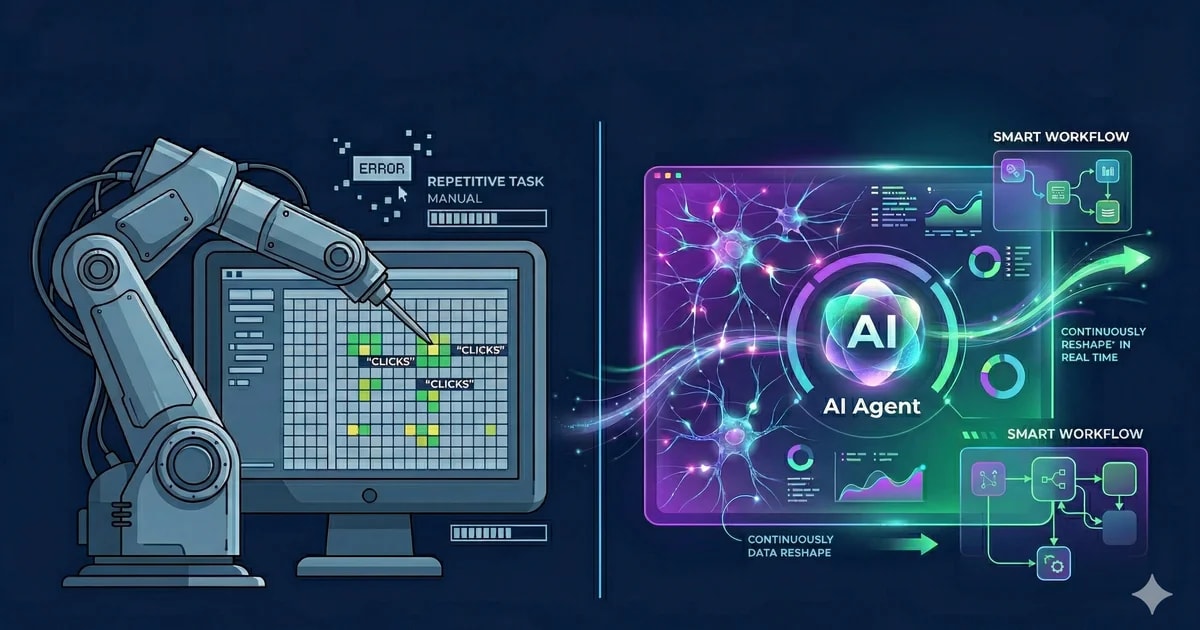
RPA bots work by mimicking human actions at the pixel level: memorizing clicks, keystrokes, and screen coordinates. For structured, predictable workflows, this is genuinely useful. The problem is that real enterprise operations are rarely structured or predictable.
A customer misspells their name. A vendor updates their portal layout. An insurance form adds a required field. Any one of these breaks the bot.
The result is the 80/20 problem that every RPA implementation team knows intimately: the bot handles roughly 80% of a workflow, but the remaining 20% consists of edge cases that defeat even the most carefully engineered automation. That 20% lands back on human operators. The back office never actually shrinks. It just shifts.
Organizations end up maintaining a hybrid of bots and human exception handlers, absorbing maintenance overhead for every process change, and managing the frustration of an automation program that requires a dedicated team to keep running.
What Every Incumbent Is Actually Building
The financial results tell one story. The product roadmaps tell another.
UiPath is pivoting hard to what it calls Agentic AI: Agent Builder, Agentic Orchestration, and Maestro. The company recently launched an AI-powered Agentic ERP offering with Deloitte and reported $200 million in AI-product ARR. Analysts are cautiously optimistic but skeptical. The central question from every sell-side desk is whether UiPath can successfully monetize AI in an environment where Microsoft is giving similar capabilities away bundled into its existing productivity subscriptions.
Automation Anywhere has gone further, fastest. Its Agentic Process Automation (APA) system (which orchestrates teams of AI agents, bots, and APIs using large language models) achieved a 38% attach rate within its existing customer base and drove 90% year-over-year growth in bookings. Clients have already executed over 655,000 AI agents. That is not an adjacent feature; that is a platform pivot.
Pegasystems is betting on enterprise AI decisioning and workflow automation, crediting AI innovation directly for its 9% ACV growth and record cash flow. Client reactions to its newest AI-powered solutions are reportedly strong.
SS&C Technologies (Blue Prism) is playing the long game, using its deep industry expertise and proprietary technology as a competitive moat while it carefully layers in AI capabilities. Leadership sees generative AI as directly complementary to its core strength: automating high-volume, repetitive tasks.
Microsoft is the wild card that keeps every automation vendor CEO up at night. Power Automate, tightly bundled with Microsoft 365 Copilot at 15 million paid users, is capturing market share simply by being already installed. Azure grew 39% year-over-year in Q2 FY26, largely driven by enterprise demand for AI workloads. Microsoft is not building an automation company; it is turning automation into an infrastructure layer.
What Intelligent Agents Do That RPA Cannot
The common thread in every pivot above is the same: moving from deterministic bots to systems that can reason about what they are doing.
Unlike RPA, intelligent AI agents can:
- Process unstructured data: scanned documents, emails, PDFs, and free-text fields that RPA cannot parse
- Understand context: reason about what a document means, not just where fields are positioned on screen
- Adapt to change: handle variations in format, layout, and input without breaking
- Escalate intelligently: surface genuinely ambiguous cases for human review rather than failing silently
That last point is critical and often undervalued. The goal of intelligent automation is not to remove humans from every decision. It is to remove humans from the robotic parts of their jobs while keeping them accountable for decisions that matter. At lowtouch.ai, every agentic workflow includes commit reviews by developers and pull request approvals by leads. The humans stay in the loop; they just stop doing data entry.
A Real Example: Healthcare Referrals
Consider how a primary care referral used to work. A physician faxes a referral. A front-desk administrator manually reviews the patient record, checks insurance coverage, and keys data into a scheduling system. The workflow is too variable for traditional RPA: insurance policies differ, forms vary by provider, clinical notes arrive in dozens of formats.
Today, companies like Tenor are using intelligent automation to handle this end to end. Instead of programming every click an administrator makes, modern platforms offer drag-and-drop workflow configuration that handles the complexity under the hood, escalating only the genuinely ambiguous cases to a human reviewer.
The outcome is not just cost reduction. It is faster referrals, fewer errors, and staff spending time on work that requires human judgment rather than mechanical transcription.
The Market Framing Most Analysts Get Wrong
The automation market is often sized by looking at what RPA vendors currently charge per seat. That is the wrong baseline.
Intelligent automation does not just replace legacy software. It unlocks labor budgets by successfully automating work that no prior technology could touch. Every back-office function that RPA could partially automate but never fully close is now on the table. The total addressable market is not "RPA revenue times some growth multiple"; it is a meaningful share of the global services labor budget. That is a substantially larger number.
This is why Automation Anywhere's pivot to APA is the most strategically interesting move in the sector right now. It is not trying to defend its existing bot business. It is trying to be the platform that sits on top of everything: bots, agents, APIs, and humans, orchestrated by LLMs. If it works, the TAM expands dramatically.
What Enterprise Leaders Should Do Now
If you are a CTO or CIO evaluating your automation strategy in 2026, a few things are clear.
Your existing RPA investment is not wasted. Bots still handle the 80% that is genuinely structured. The question is whether you are building a strategy for the 20% that RPA never could touch.
The incumbent vendors will all eventually get to intelligent agents. The question is timeline, depth of integration, and whether their platforms can truly handle the unstructured, variable data that defines real-world enterprise operations, or whether they are layering AI branding on top of fundamentally brittle architecture.
The companies that move first will compress the advantage gap. The labor budget unlocked by genuinely intelligent automation is large enough that early movers will build compounding cost structure advantages that late adopters will find difficult to close.
The fax machine had its era. So did the click-based bot. What comes next is smarter, more adaptable, and built to handle the complexity that legacy automation never could.
RPA is not dead. But it is the last generation. Every major player in the market already knows it.