Private No-Code Agentic AI · ISO 27001 · SOC 2 Type 2
AI Agents That Run in
Your Infrastructure.
Deployed in Weeks, Not Months.
Private, no-code agentic AI for enterprises. Build production-ready agents on your systems, under your control, with contracts tied to measurable outcomes.
Why lowtouch.ai
Most enterprise AI projects stall on complexity, cost, or control. We solve all three.
Security
Private by Architecture
- Your data never leaves your perimeter. Ever.
- Air-gapped deployments fully supported.
- SOC 2 Type 2 & ISO 27001 certified.
Speed
No-Code, No Waiting
- Live in 4–6 weeks, not 6–12 months.
- Zero AI engineers required on your side.
- Pre-built catalog of production-ready agents.
Control
Governed Autonomy
- Every critical action requires human sign-off.
- Full thought-logging — nothing runs in the dark.
- Agentic workflows keep every action auditable.
Value
Outcome-Based Contracts
- Pay for measurable results, not licenses.
- No ROI hit? You don't pay. Simple.
- Most customers see payback in Q1.
Certified
ISO 27001
Attested
SOC 2 Type 2
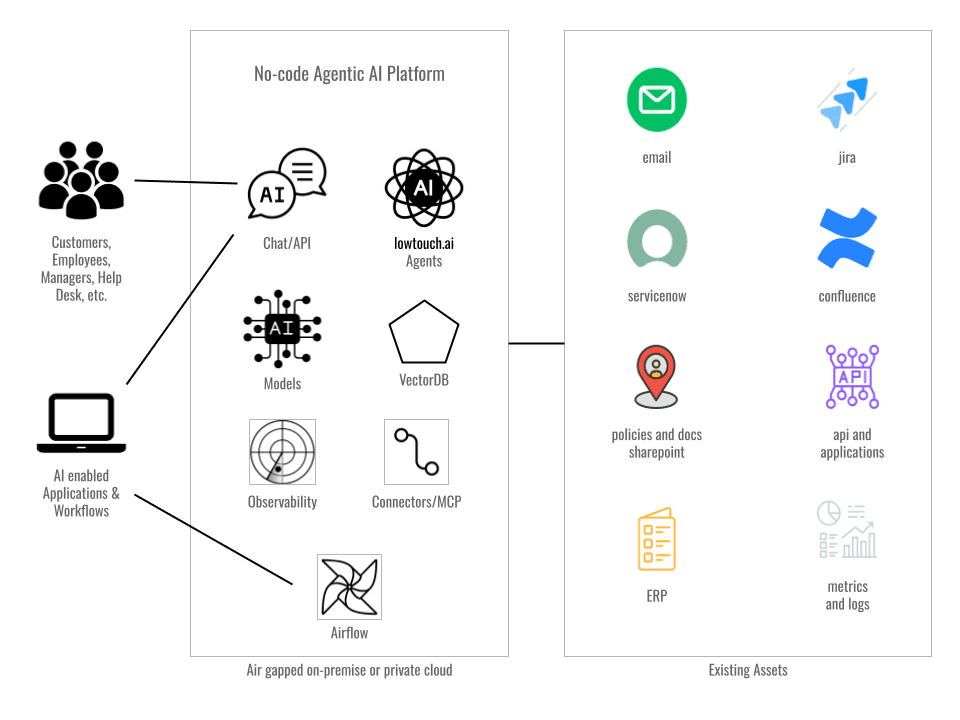
Platform
The platform your security team will approve.
Latest from the AI Academy
Practical guides, research, and case studies on deploying AI automation in enterprise environments.
Agentic AI vs Generative AI: Key Differences, Real-World Use Cases, and Which One Your Business Actually Needs
Generative AI drafts outputs on demand. Agentic AI runs goal-directed workflows end to end. Here is the decision framework enterprise leaders need in 2026.
- Generative AI produces artifacts on demand; agentic AI pursues goals across multi-step workflows
- Agentic systems use generative models as a reasoning engine, so this is a stack decision, not a versus
- ️ Enterprise wins come from pairing LLM orchestration with HITL gates, audit trails, and private deployment
- Decision rule: if the outcome is a document, pick generative; if the outcome is a completed process, pick agentic
- ️ 2026 trend: multi-agent systems plus agent communication protocols move orchestration from demo to production

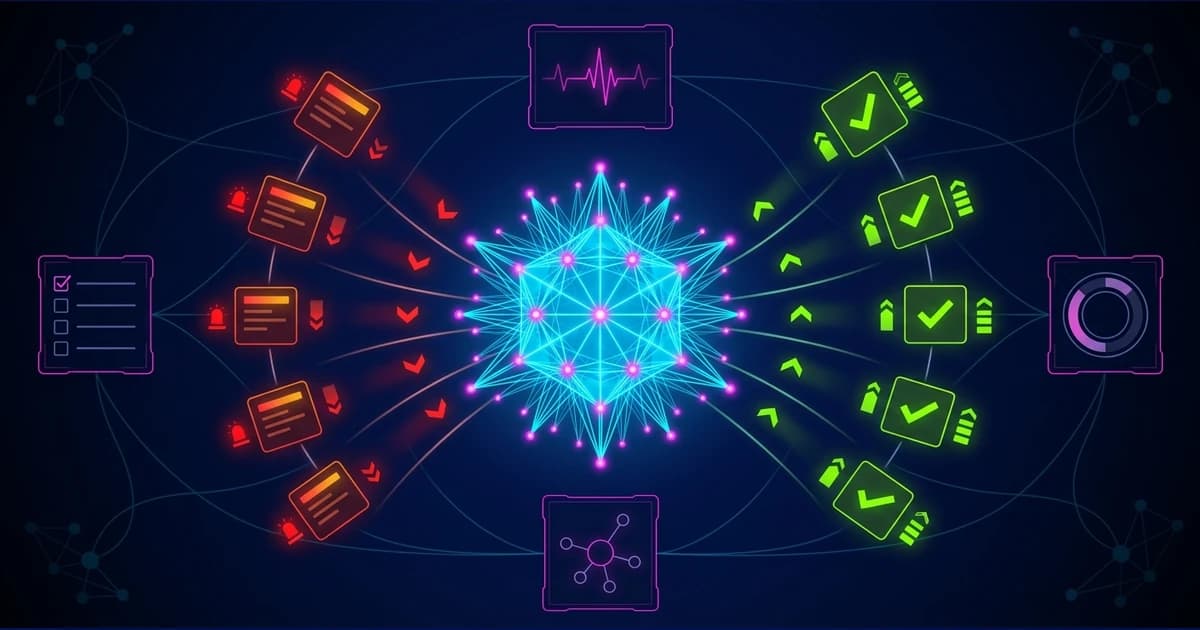
Agentic AI in ITSM: How Autonomous Agents Are Transforming IT Service Management
Agentic AI moves ITSM past chatbots to autonomous incident detection, ticket routing, and runbook execution. Here is the enterprise playbook for 2026.

What Is ReAct in Agentic AI? How the Reasoning + Acting Framework Powers Autonomous Agents
ReAct is the Reasoning + Acting prompting framework introduced by Yao et al. in 2022, and it is the architectural backbone of nearly every production agentic AI system shipping in 2026. Here is what it actually is, why it works, and how enterprise teams should think about it.

Claude Opus 4.7: What Anthropic’s New Frontier Model Means for Enterprise AI
Claude Opus 4.7 lands with a 13% lift on SWE-bench Verified, 3x more production tasks resolved on Rakuten SWE-Bench, and sharper long-horizon agent behaviour. Here is what it means for enterprise CTOs evaluating private, governed AI deployment — and what the benchmark gains do not change.