The RFP Response Time Problem Is a Revenue Problem
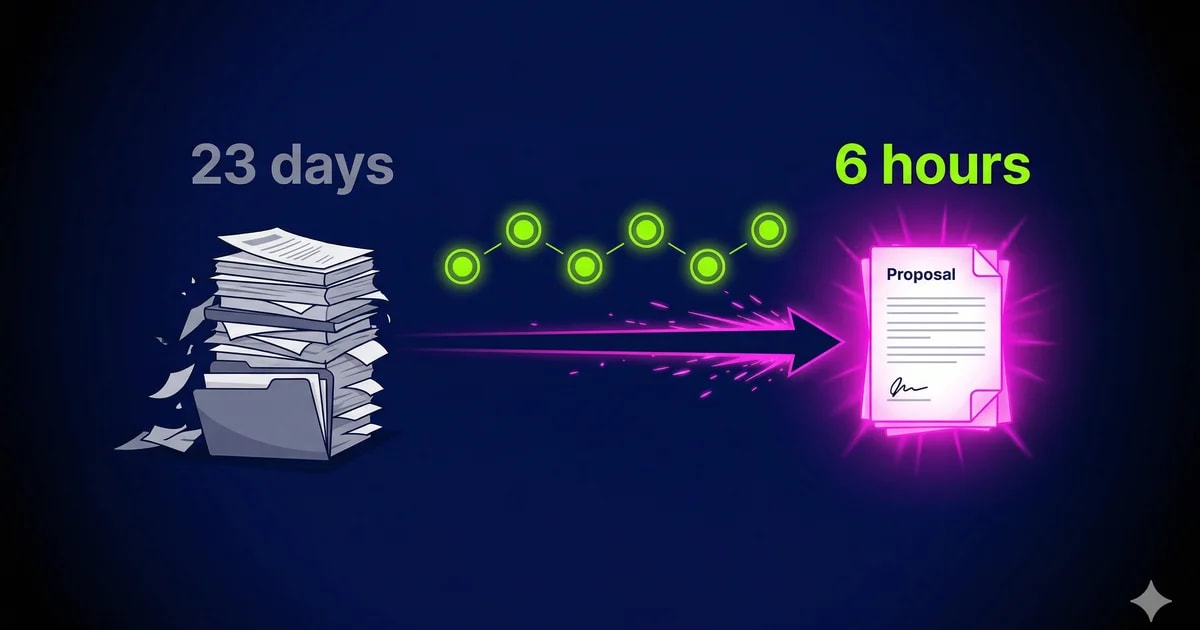
The average enterprise proposal team spends 23 working days responding to a single RFP. That number comes from Bidara's 2026 RFP benchmarks, and it matches what proposal managers report consistently: two to four weeks from document receipt to final submission, with 10 or more subject-matter experts pulled off active work for each bid.
That timeline creates three compounding problems:
Speed: Faster competitors submit complete, compliant responses while your team is still assembling the intake group. In competitive RFPs, submission timing signals organizational readiness. Slow responses lose before they are read.
Capacity: If each RFP takes 23 days and locks up the same SMEs, you cannot run parallel bids. Most teams manage one or two active RFPs at a time. Every RFP you decline is a pipeline opportunity surrendered.
Quality variance: When response quality depends on which SME had bandwidth on which day, quality degrades under deadline pressure. There is no institutional baseline; every bid starts from scratch.
AI-native RFP automation solves all three by making the knowledge base the constant, and human judgment the exception rather than the default.
RFP Response Time Benchmarks: What Is Realistic?
Before diving into the workflow, it helps to anchor on what is actually achievable. Based on published data from the 2026 RFP automation market:
| Approach |
Avg. Response Time |
Automation Rate |
| Manual (no tooling) |
23 working days |
0% |
| Legacy RFP software (Loopio, Responsive) |
15 working days |
40–60% |
| AI-native automation (rfp_rfi_agent) |
Under 6 hours |
80%+ |
For enterprises evaluating Loopio or Responsive, see how an AI-native platform compares on HITL controls and private deployment.
The difference between legacy tools and AI-native tools is not incremental. Legacy platforms are content libraries with search: humans still write most of the response. AI-native platforms use subagents to generate sourced drafts, detect compliance gaps before drafting, and route only the edge cases to humans. That is a 6-hour cycle, not a 15-day one.
How AI Automates RFP Responses: The Six-Subagent Workflow
The rfp_rfi_agent agentic workflow uses specialized subagents, each owning one stage of the process. No stage is skipped; every submission carries a full audit trail.
Stage 1: Knowledge Ingestion
Before any RFP is received, the Knowledge Ingestion Agent indexes your existing materials: past proposals, product specification documents, policy documents, compliance certifications (SOC 2 Type 2, ISO 27001, sector-specific attestations), and reference case studies. This runs once and updates continuously as new documents are added.
The output is a structured retrieval layer: every fact, claim, and certification is sourced to an origin document and queryable by the downstream agents.
Stage 2: Document Intake and Sensitivity Routing
When the RFP or RFI document arrives, the Document Intake and Routing Agent does two things simultaneously. It parses the document into a structured requirement matrix (every requirement, evaluation criterion, and compliance checkpoint extracted and categorized). And it scans for sensitivity markers: NDA language, ITAR, GDPR, or HIPAA references, or procurement portal classification flags.
If sensitive content is detected, a HITL gate fires: a named reviewer confirms the routing decision before any generation begins. Sensitive bids route to an air-gapped on-premise inference path; standard bids proceed through the normal pipeline. This decision is logged and attributed.
Stage 3: Gap Detection
The Gap Detection Agent cross-references every extracted requirement against the knowledge base before drafting begins. Unanswered sections, missing certifications, and evaluation criteria without a matching source document are flagged at this stage.
This is the critical shift from reactive to proactive compliance: gaps surface when they can still be addressed, not after submission.
Stage 4: Draft Generation
The Draft Generation Agent auto-populates responses using matched knowledge base content. Every generated response is sourced to its origin document: policy doc section, past proposal paragraph, or certification record. Response tone is consistent across the document regardless of which section is being answered.
RFI capability matrices, headcount tables, and certification registers are handled here alongside traditional RFP narrative sections.
Stage 5: HITL Review
Flagged sections (those touching pricing, SLA commitments, security attestations, or compliance claims) route to named SME reviewers via commit reviews and pull request approvals. Reviewers see the draft response, the source document it was drawn from, and the specific requirement it addresses.
Nothing in the final submission is unreviewed. Every approval is attributed to a named reviewer and timestamped.
Stage 6: Submission
The Submission Agent compiles the reviewed proposal into the required format: Word, PDF, or direct portal upload. Every response version is archived, every reviewer logged, every source document linked. The submission package is audit-ready on first pass.
Practical Impact: What Changes When You Automate
Response time drops from weeks to hours. The 23-day manual cycle compresses to under 6 hours for a standard enterprise RFP. The first-pass draft is ready for human review the same day the document arrives.
SMEs spend 8–12 fewer hours per bid. The agentic workflow handles synthesis, drafting, and compliance checking. SMEs review flagged sections rather than writing from scratch. That time returns to billable delivery and client work.
Bid volume scales without headcount. Subagents operate in parallel across concurrent bids. Running three simultaneous RFPs does not require three times the team. The knowledge base is the shared resource; human reviewers only touch the decisions that require judgment.
Quality compounds over time. The knowledge base indexes reviewer edits and incorporates learnings from closed bids. Best-performing answer templates are reused automatically. Win/loss patterns inform knowledge base pruning. Every submission is stronger than the last.
How to Automate Your RFP Process: Getting Started
The rfp_rfi_agent workflow deploys on your existing infrastructure. No rip-and-replace required; the system connects to SharePoint, Confluence, Salesforce, and your existing review tools (SNOW, Jira, MS Teams) through standard APIs.
Deployment follows three steps:
- Knowledge base indexing: Connect your existing document repositories. The ingestion agent indexes them and builds the retrieval layer. This typically completes within 24–48 hours depending on corpus size.
- Routing configuration: Define your sensitivity rules (which document types trigger air-gapped routing, which sections require mandatory HITL review) and connect your reviewer notification channels.
- First live bid: Run your next incoming RFP or RFI through the workflow. Review the gap detection output, approve or edit the draft sections via the HITL gate, and submit. The knowledge base learns from reviewer edits immediately.
Summary
Manual RFP and RFI response is a 23-day process that locks up your best technical talent, limits bid volume, and produces inconsistent quality. AI-native automation cuts response time to under 6 hours, automates 80% of content from your knowledge base, and routes only the decisions that require human judgment to named reviewers.
The win rate industry average is 45%. Higher-quality, compliance-complete responses improve that number. The knowledge base compounds with every closed bid.
If your team is currently spending two to four weeks per RFP, that timeline is the problem to solve first. The technology to solve it exists today.
Learn how the rfp_rfi_agent agentic workflow is built