Every few years, something shifts in how we think about work. We're in one of those moments now.
If you've spent any time with Claude Code, OpenClaw, or Cursor recently, you know what I'm talking about. These aren't just better tools. They're different tools. They don't assist you with your work. They do the work. And if you've run more than one of them simultaneously (which, if you're reading this, you probably have), you've hit the wall that Paperclip was built to solve.
Here's the problem: we now have agents that can write production code, debug live systems, generate entire features, and interact with complex enterprise workflows. But we don't have a way to run them like a company. We're managing them like scripts. We're tracking them in browser tabs. We're losing context when we reboot. We're manually stitching together what one agent learned so another agent can use it. We're essentially running an org chart in our heads while trying to prevent runaway API costs and remember which terminal window is deploying to staging.
Paperclip changes this. It's not another agent. It's the organizational layer that sits above your agents. If OpenClaw is an employee, Paperclip is the company.
The Numbers Tell the Story
The growth trajectory speaks for itself. OpenClaw launched in late January 2026 and crossed 347,000 GitHub stars in four months. That's faster than any open-source project in history. React took over 10 years to hit 250,000 stars. OpenClaw did it in 60 days.
GitHub Stars: Total by April 2026
Cumulative stars as of April 2026 · Source: GitHub
Paperclip launched on March 2, 2026. Within three weeks, it had crossed 41,000 stars. To put that in context, CrewAI has 44,500 stars after a much longer runway. The velocity isn't hype. It's demand. People aren't starring these projects because multi-agent coordination sounds interesting in theory. They're starring them because they've felt the pain.
The broader ecosystem confirms it. OpenClaw now has 2 million monthly active users, 27 million monthly website visitors, and a community that's built 13,729 skills on ClawHub. Traffic grew 925% month-over-month between February and March 2026. Startups built on OpenClaw are generating $361,000 in monthly revenue. This isn't speculative. This is production.
OpenClaw Ecosystem by the Numbers (March 2026)
2M+
Monthly Active Users
Active developers
13,729
ClawHub Skills
Community built
27M
Website Traffic
Monthly visitors
$361K
Ecosystem Revenue
172 startups (monthly)
The Zero-Human Company Isn't a Metaphor
The tagline on Paperclip's GitHub page is "open-source orchestration for zero-human companies." That sounds like sci-fi. It's not. It's a very specific, very pragmatic architecture decision.
What Paperclip does is simple in concept and hard in execution. It gives you a way to define business goals, hire a team of AI agents to achieve them, assign roles and reporting structures, set budgets, track work, approve strategies, and monitor everything from a single dashboard. You're not babysitting terminals. You're running a company.
Let's break down what that actually means.
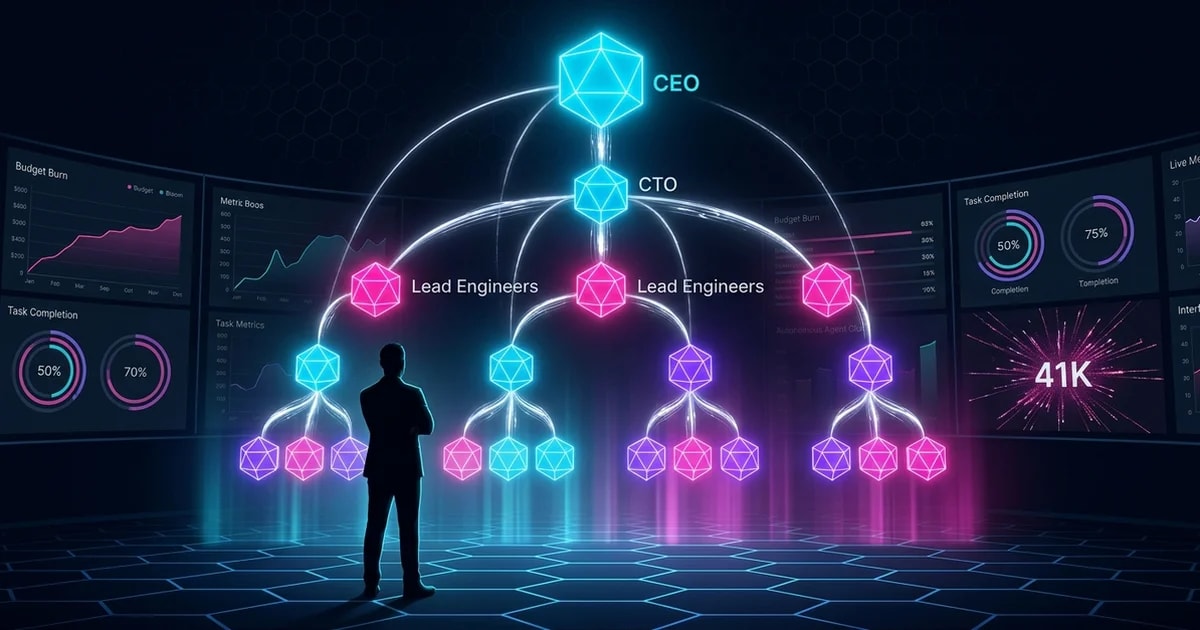
Goal structure. You don't tell agents what to do. You tell them what you're trying to achieve. "Build the number one AI note-taking app to $1M MRR." That's the mission. The agents figure out the tasks. The CEO agent defines strategy. The CTO agent hires engineering agents. The engineers write code. Marketing agents run campaigns. Finance agents track spend. You review, approve, adjust, and let them execute.
The org chart. Every agent has a role, a boss, and a job description. They communicate up and down the reporting structure. Context flows naturally. If the CEO pivots strategy, everyone downstream knows why. If an engineer hits a blocker, they escalate to their manager, who escalates if needed. This isn't a pile of scripts. It's a hierarchy with accountability.
Governance. You're the board. You can approve hires, override decisions, pause agents, set budgets, or terminate anyone at any time. Agents don't go rogue because you're always in the loop. But you're not micromanaging every line of code. You're setting direction and reviewing outcomes. That's the difference between orchestration and chaos.
Why This Matters Now
We're at a tipping point. The quality bar for AI-generated work has crossed into production-ready territory. Claude Sonnet 4.5 writes code I'd ship. OpenClaw can debug a live incident faster than most junior engineers. Cursor can scaffold an entire feature in minutes. The bottleneck isn't capability anymore. It's coordination.
The data proves it. OpenClaw didn't just beat React's GitHub milestone. It destroyed the timeline. React needed 3,650 days to reach 250,000 stars. OpenClaw needed 60. Paperclip hit 30,000 stars in 21 days. These aren't vanity metrics. They're signals that the market has shifted from "can AI do this?" to "how do I manage AI doing this at scale?"
Speed to Scale: Days to Reach Major GitHub Milestone
Logarithmic scale. A shorter bar means faster adoption. Sources: GitHub, public announcements
Paperclip (30K stars)
21 days
OpenClaw (250K stars)
60 days
Kubernetes (120K stars)
~9 years
React (250K stars)
10 years
Linux (195K stars)
30 years
If you're running a software company, a SaaS product, or an enterprise IT operation, you've probably experimented with agents. Maybe you've got a few handling support tickets. Maybe one writing documentation. Maybe another running database migrations. And if you're doing this at any scale, you've realized the next problem: how do I manage ten agents? Twenty? Fifty? How do I make sure they're working on the right things, not duplicating effort, staying within budget, and producing auditable work?
You can't do it manually. It doesn't scale. You need an orchestration layer. You need Paperclip.
How It Works
Paperclip is a Node.js server and React UI. You define goals, hire agents, and assign tasks. Agents operate on heartbeats (scheduled wake-ups to check for work) and event-based triggers: new task assignments, mentions, escalations. Every conversation is logged. Every decision is explained. Full tool-call tracing. Immutable audit log. Cost tracking per agent with budget enforcement.
Critically, Paperclip is runtime-agnostic. Bring your own agents: OpenClaw, Claude Code, Codex, Cursor, a bash script, an HTTP endpoint. If it can receive a heartbeat, it's hired. You're not locked into one model, one provider, or one framework. You orchestrate heterogeneous teams the same way you'd run a human company with contractors, employees, and vendors.
The interface feels like a task manager. That's intentional. You don't need to learn a new paradigm. You assign tasks. Agents pick them up. You review their work. You approve or send it back. The complexity (context injection, session persistence, budget atomicity, delegation logic) is handled under the hood.
AI Agent Ecosystem: GitHub Stars Comparison
Total stars as of April 2026 · Source: GitHub
The project already ships with 16 pre-built company templates: content agencies, development shops, consulting practices, security firms, game studios, investment analysis teams. You can import an entire AI workforce in minutes and start running. The upcoming Clipmart marketplace will let you download and deploy full companies with one click.
What Changes When You Use It
The shift is subtle but profound. You stop thinking in terminals and start thinking in outcomes. Instead of "I need to kick off this agent to handle customer support," you think "customer support is a function that needs to run 24/7 with escalation paths to engineering and a $500/month budget." You define the function. Paperclip handles the execution.
This unlocks things that aren't feasible today:
- SRE teams that triage incidents, apply fixes, and escalate only when needed, running with minimal human interaction between incidents
- Marketing operations that run continuously (content generation, SEO optimization, social scheduling) without human intervention between strategy reviews
- Pre-sales engineering agents that qualify leads, generate proposals, and hand off to human closers only when the deal is real
- FinOps teams that monitor cloud spend, identify waste, and automatically apply optimizations within approved guardrails
You're not replacing humans. You're augmenting capacity in ways that weren't possible before. And critically, you're doing it with governance baked in from day one.
Why Governance Matters (Especially for Enterprises)
If you're running a business, governance isn't optional. You need to know who did what, why they did it, and what it cost. You need audit trails. You need approval gates. You need the ability to roll back bad decisions. You need human-in-the-loop controls.
Paperclip gives you all of this. Every task traces back to a goal. Every action is logged. Budgets are enforced atomically (no runaway spend). Agents resume context across sessions instead of starting from scratch. Configuration changes are versioned. You can export entire org structures (agents, goals, skills) and import them elsewhere with secret scrubbing and collision handling.
This is what makes Paperclip production-ready for enterprises. It's not a toy. It's not a prototype. It's an orchestration layer designed for regulated industries, compliance requirements, and real financial accountability.
At lowtouch.ai, we believe in governed agents. We build private, no-code Agentic AI platforms for enterprises that need production-grade AI with zero custom code. Governance is the foundation. You can't run AI at scale without it. Paperclip gets this right.
What's Next
In a few months, you'll be managing your AI teams from your phone. You'll define a goal, approve a strategy, and check in once a day to review progress. Your agents will be your direct reports. They'll have their own teams. They'll escalate when they need you. Otherwise, they'll execute.
This isn't speculative. Paperclip is live. It's open source. You can run it today at github.com/paperclipai/paperclip. The community is building company templates (full org structures, agent configs, skills) that you'll be able to download and deploy with one click via Clipmart. Entire businesses, pre-configured, ready to run.
If you're not experimenting with this yet, start now. Clone the repo. Run npx paperclipai onboard --yes. Define a goal. Hire a team. See what happens. The learning curve is steep, but the leverage is exponential.
We're moving from a world where we use AI as a tool to a world where we run companies made of AI. Paperclip, OpenClaw, and Claude Code are the vanguard. The next few months will separate the people who understand this shift from the people who don't.
The question isn't whether this is coming. It's whether you'll be ready when it arrives.
Related reading on agentic AI governance:
Start Today