Claude Code CLI vs GitHub Copilot: Why Agentic Workflows Are Essential for Database Migration
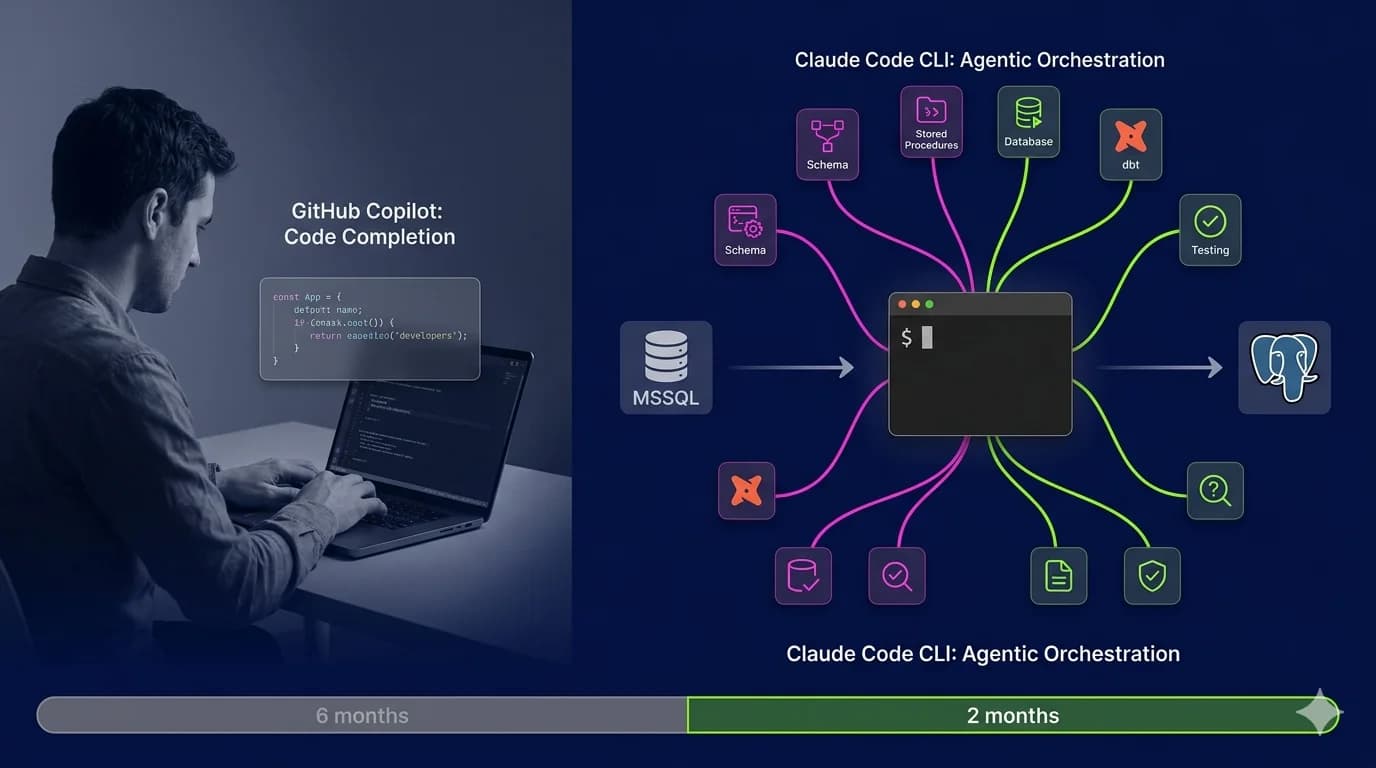
GitHub Copilot suggests code. Claude Code CLI migrates your entire database estate (schema, stored procedures, performance validation, and audit trail) with minimal human interaction in 2 months instead of 6.
Agentic orchestration vs code completion: a fundamentally different problem class
12 custom subagents built by the lowtouch.ai team handle schema, procedures, dbt, testing, and compliance
6-month manual migration compressed to 2 months with full automation
Auto-generated audit trail for ARB review, SOC 2, and compliance validation
Browser automation creates regression tests where no test suite exists
·10 min read
Executive Summary
Enterprise database migration (moving a legacy MSSQL estate to PostgreSQL) sits among the highest-risk, highest-cost infrastructure programs any organization tackles. The typical approach ties up multiple DBAs and developers manually translating schemas, rewriting stored procedures, rebuilding dbt models, and validating data integrity across 4–6 months. Human error is a real risk, and every week of delay has a direct headcount cost.
This whitepaper compares two AI coding tools (GitHub Copilot and Claude Code CLI) through the lens of a real MSSQL-to-PostgreSQL migration. The core argument: they are solving fundamentally different problems. GitHub Copilot is a code completion accelerator for individual developers. Claude Code CLI is an agentic orchestration platform capable of executing multi-phase migration workflows with minimal human intervention.
The distinction matters enormously when the scope of work is not a feature; it is an entire database estate.
The Problem Class: Why Code Completion Is Not Enough
When most engineering leaders evaluate AI coding tools, they benchmark developer productivity: lines of code per hour, test coverage improvements, reduced context-switching. GitHub Copilot performs well here. It has earned broad adoption by reducing the friction of routine coding tasks.
But database migration is not a developer productivity problem. It is a systems orchestration problem.
A production MSSQL-to-PostgreSQL migration involves:
Stored procedure rewriting: translating hundreds of T-SQL stored procedures, triggers, and functions to PL/pgSQL, handling dialect-specific constructs such as @@ROWCOUNT, NOLOCK hints, PRINT statements, and temporary table semantics
dbt model rebuilds: recreating transformation logic using PostgreSQL-compatible SQL, updating {{ source() }} and {{ ref() }} references
Data movement: bulk extraction from MSSQL, transformation, and load into PostgreSQL with validation
Performance baseline: establishing query execution plans in PostgreSQL and tuning against MSSQL benchmarks
Regression testing: verifying application behavior post-migration, including UI flows, API responses, and report outputs
Compliance documentation: producing audit-ready artifacts for Architecture Review Boards (ARBs), SOC 2 auditors, and data governance teams
GitHub Copilot can help a developer rewrite a single stored procedure, one at a time, with the developer driving every decision. For an estate of 200 stored procedures, that is still a 6-month project with a team of four.
Claude Code CLI can orchestrate all of it.
What Is Agentic AI Execution?
The term "agentic AI" is overloaded in vendor marketing. Here, it means a specific capability: an AI system that can decompose a complex goal into subtasks, execute those subtasks with minimal human interaction in sequence (or in parallel), use tools (file system, terminal, browser, APIs), and produce verified outputs. Human oversight happens at natural checkpoints: developers review and sign off commits, and engineering leads approve pull or merge requests. The pipeline does not pause for approval on every individual action.
Claude Code CLI implements this through a subagent architecture. The lowtouch.ai team defines a skill (a structured prompt with a defined interface), and Claude Code orchestrates multiple specialized subagents to execute it. Each subagent operates in its own context, uses specific tools, and hands off verified outputs to the next stage.
That is a fundamentally different model from GitHub Copilot, where the human developer remains the orchestrator and AI serves as a context-aware suggestion engine.
Migration Architecture: 12 Custom Subagents, One Coordinated Pipeline
For a production MSSQL-to-PostgreSQL migration, the lowtouch.ai team built 12 custom subagents that Claude Code CLI orchestrates as a coordinated pipeline:
Subagent
Responsibility
schema-analyzer
Parses MSSQL DDL, identifies data type mappings, FK relationships, index patterns
migrate-schema
Writes PostgreSQL DDL with full conversion audit log per table
procedure-analyzer
Catalogs stored procedures by complexity, dependency, and T-SQL dialect usage
procedure-rewriter
Rewrites each procedure to PL/pgSQL, flags manual review items
dbt-migrator
Updates dbt models for PostgreSQL dialect, rebuilds sources.yml
data-extractor
Generates MSSQL bulk export scripts with checksum validation
data-loader
Executes PostgreSQL COPY commands with row count and checksum verification
query-profiler
Captures baseline query execution plans from MSSQL production
perf-validator
Runs equivalent queries in PostgreSQL, compares execution plans and latency
test-generator
Uses browser automation to capture UI flows as regression test specifications
test-runner
Executes regression tests against the migrated PostgreSQL instance
compliance-reporter
Aggregates per-table, per-procedure conversion summaries into an ARB-ready report
Each subagent produces structured output that feeds the next. The entire pipeline is reproducible, version-controlled, and re-runnable on schema changes, all properties that manual migration cannot match.
Schema Migration in Practice
The /migrate-schema skill is the entry point for schema conversion. Given a target MSSQL table name, Claude Code CLI:
Reads the source DDL from the migration input directory
Maps T-SQL data types to PostgreSQL equivalents (e.g., DATETIME2 → TIMESTAMPTZ, NVARCHAR(MAX) → TEXT, UNIQUEIDENTIFIER → UUID)
Converts identity columns to SERIAL or BIGSERIAL with appropriate SEQUENCE definitions
Translates CHECK constraints and removes MSSQL-specific index hints
Writes the output PostgreSQL DDL to the migration output directory
Produces a structured conversion summary documenting every transformation applied
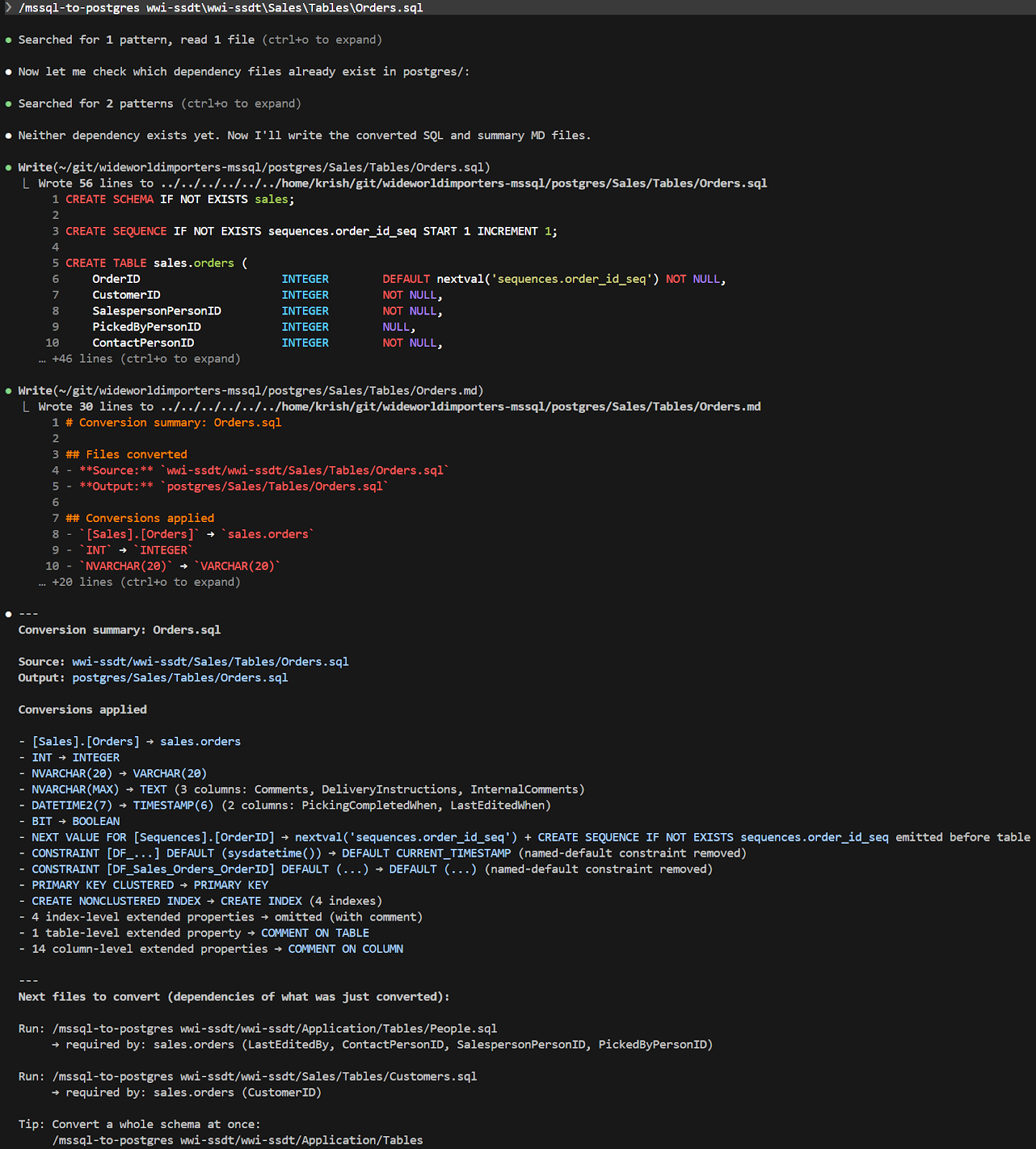
Figure 1: Automated schema migration in action: Claude Code CLI executing the /migrate-schema skill, writing PostgreSQL DDL conversion files including table definitions, sequences, and constraint mappings translated from MSSQL T-SQL.
The terminal output in Figure 1 shows Claude Code CLI writing multiple output files in a single pass: the base table DDL, the sequence definitions, and the constraint scripts. This is not code suggestion; it is file system execution. The developer reviews the output; they do not drive it line by line.
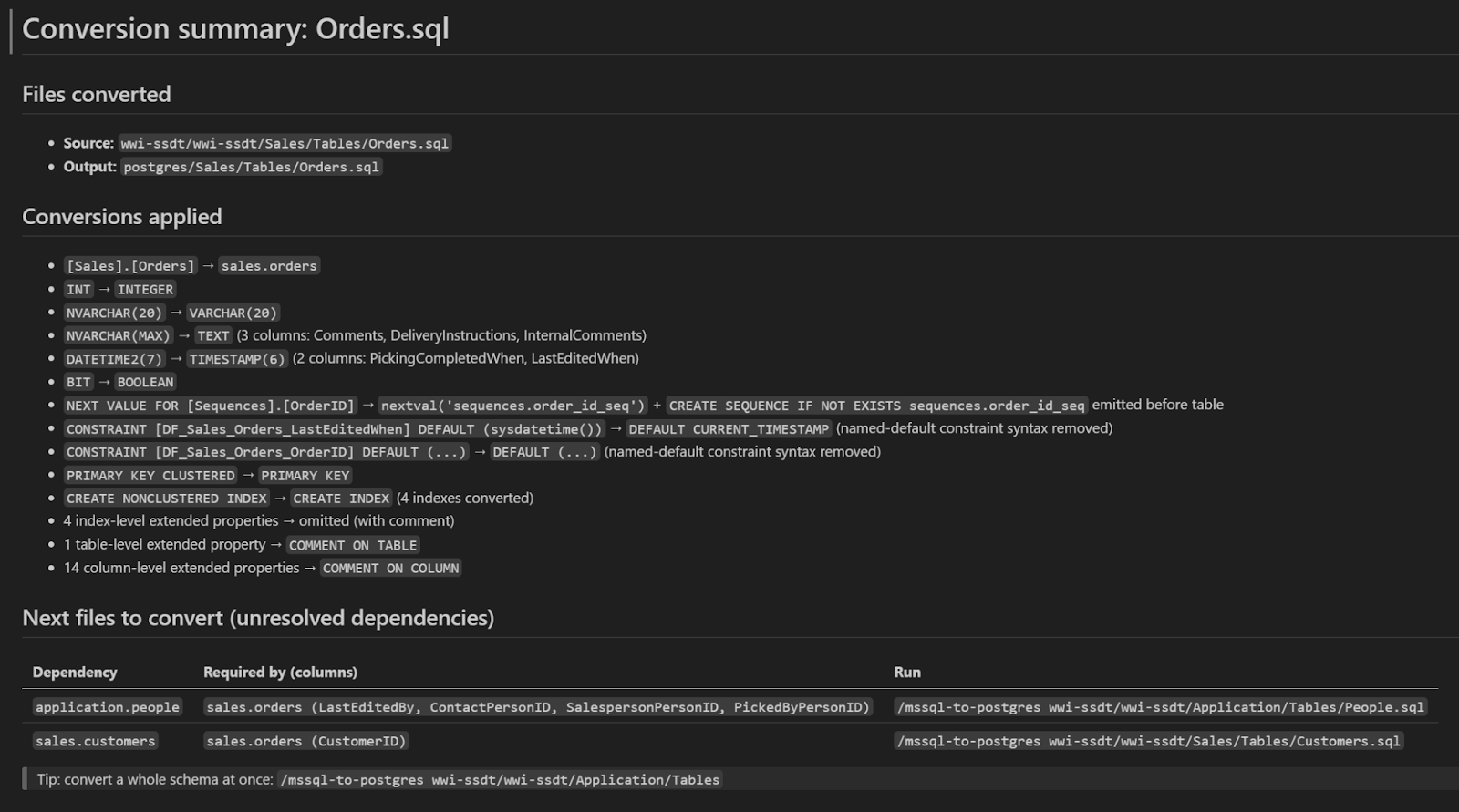
The conversion summary (Figure 2) is equally important. For each migrated table, Claude Code generates a structured record of every transformation applied, every removed constraint, and the dependency queue (the ordered list of tables that must be migrated before this one can be loaded to satisfy foreign key constraints).
Figure 2: Automated conversion summary: The /migrate-schema skill generates a structured audit report for Orders.sql documenting all schema transformations applied (data type mappings, constraint translations, index conversions). The dependency table identifies unresolved cross-table references and provides the exact execution order for safe migration, ensuring referential integrity constraints are satisfied. This auto-generated documentation becomes part of the version-controlled migration artifact for compliance and ARB review.
This audit artifact, generated automatically for every table, becomes the version-controlled source of truth for the migration. It is the document your ARB reviewers and SOC 2 auditors will ask for. With a manual migration, producing this documentation is a separate workstream; with Claude Code CLI, it is a by-product of execution.
Stored Procedure Migration: The Hard Part
Schema migration is tractable. Stored procedure migration is where most MSSQL-to-PostgreSQL projects stall.
T-SQL and PL/pgSQL are not dialects of the same language. They differ in:
Error handling: T-SQL uses TRY/CATCH with @@ERROR; PL/pgSQL uses EXCEPTION WHEN
Temporary tables: T-SQL #temp tables persist for the session; PL/pgSQL uses CREATE TEMP TABLE with ON COMMIT DROP
String operations: T-SQL CHARINDEX, STUFF, PATINDEX have no direct PL/pgSQL equivalents
Dynamic SQL: T-SQL sp_executesql vs PL/pgSQL EXECUTE ... USING
Locking hints:NOLOCK, UPDLOCK, ROWLOCK must be replaced with PostgreSQL transaction isolation settings
The procedure-analyzer subagent first classifies each stored procedure by complexity and dialect-specific construct usage. This triage step is essential: it identifies the procedures that can be mechanically translated (typically 60–70% of the estate) from those requiring manual review (the remaining 30–40%).
The procedure-rewriter subagent handles the mechanical translation tier with minimal human interaction and flags each manual-review item with the specific construct and the recommended PostgreSQL equivalent. The developer's time goes to exceptions, not routine work.
Performance Validation: Beyond "Does It Run?"
A migrated database that produces correct results but degrades query performance by 40% is not a successful migration. Performance validation is the step most commonly skipped in under-resourced migrations, and the one most likely to surface as a production incident three months post-cutover.
The query-profiler subagent captures the execution plan and latency of a defined query set against the MSSQL production database. After migration, the perf-validator subagent runs the equivalent queries against PostgreSQL and produces a comparison report.
Where performance regressions exceed a defined threshold (e.g., >20% latency increase), the subagent generates index recommendations and query rewrites for review. This is not automated tuning; it is automated identification of the tuning targets, which a DBA then addresses.
Regression Testing Without a Test Suite
One of the most common challenges in legacy database migrations is the absence of a regression test suite. Applications built on MSSQL often predate modern testing practices; the "test suite" is whatever manual QA the team runs.
The test-generator subagent addresses this using browser automation. Given a list of application URLs and user flows, it:
Navigates the application using Playwright
Records the sequence of interactions and the resulting UI states
Captures API responses for data-dependent views
Generates test specifications that can be replayed against the migrated application
This produces a regression test baseline from the existing application behavior, captured before migration. Post-migration, the test-runner subagent replays those tests against the new PostgreSQL-backed application and reports any divergence.
Claude Code Deployment Options: CLI vs IDE Extension
Claude Code is available in two deployment modes: a command-line interface (CLI) and a VS Code extension (distinct from GitHub Copilot). Both run the same agentic workflow engine; the key difference is the interaction model.
The Claude Code for VS Code extension is designed for interactive development, where the developer approves each step in real time within the IDE. This is well-suited for feature development and day-to-day refactoring with human oversight at every action.
For enterprise database migrations involving multiple applications, dozens of stored procedures, schema translation, data movement, and validation, the CLI delivers superior efficiency through batch operations and execution supervised via commit reviews by developers and pull or merge request approvals by leads, rather than step-by-step approval gates.
If organizational security policies restrict CLI installation (e.g., no terminal access to developer workstations), the Claude Code VS Code extension can execute the full migration workflow. The agentic capability is identical; the CLI simply enables faster batch execution. GitHub Copilot, regardless of which underlying model is enabled, does not offer this agentic execution model in either form factor.
Side-by-Side Comparison
Capability
GitHub Copilot
Claude Code CLI
Interaction model
Developer-driven suggestion
Agentic orchestration with HITL via commit and PR review
Schema migration
Manual, one object at a time
Automated DDL translation with audit log
Stored procedure rewriting
Suggestion-based, manual execution
Batch rewrite with triage classification
dbt model updates
Manual
Automated dialect migration
Data movement
Not applicable
Automated extraction, transformation, load
Performance validation
Not applicable
Automated baseline comparison
Regression testing
Not applicable
Browser automation test generation
Compliance documentation
Manual
Auto-generated per-object audit artifacts
Migration timeline
4–6 months (team of 4)
6–8 weeks (2 engineers + oversight)
Typical cost
High (labor-intensive)
Significantly reduced
Conclusion
GitHub Copilot is a valuable tool for developer productivity in routine software development. It is not designed for, and cannot execute, the orchestration demands of an enterprise database migration.
Claude Code CLI's agentic architecture (12 custom subagents built by the lowtouch.ai team, automated artifact generation, performance validation, and browser-based regression testing) compresses a 6-month manual migration program into 6–8 weeks. The output is not just a migrated database; it is a fully documented, version-controlled, compliance-ready migration artifact.
For technology leaders evaluating AI tools for infrastructure modernization, the critical question is not "which tool has better code completion?" It is "which tool can orchestrate the entire workstream?" Only Claude Code CLI answers that question.
This whitepaper is based on production migration engagements conducted by the lowtouch.ai engineering team. Timelines and subagent counts reflect representative client scenarios; individual results vary based on estate complexity and organizational constraints.
About the Author
Rejith Krishnan
Founder and CEO
Rejith Krishnan is the Founder and CEO of lowtouch.ai, a platform dedicated to empowering enterprises with private, no-code AI agents. With expertise in Site Reliability Engineering (SRE), Kubernetes, and AI systems architecture, he is passionate about simplifying the adoption of AI-driven automation to transform business operations.
Rejith specializes in deploying Large Language Models (LLMs) and building intelligent agents that automate workflows, enhance customer experiences, and optimize IT processes, all while ensuring data privacy and security. His mission is to help businesses unlock the full potential of enterprise AI with seamless, scalable, and secure solutions that fit their unique needs.