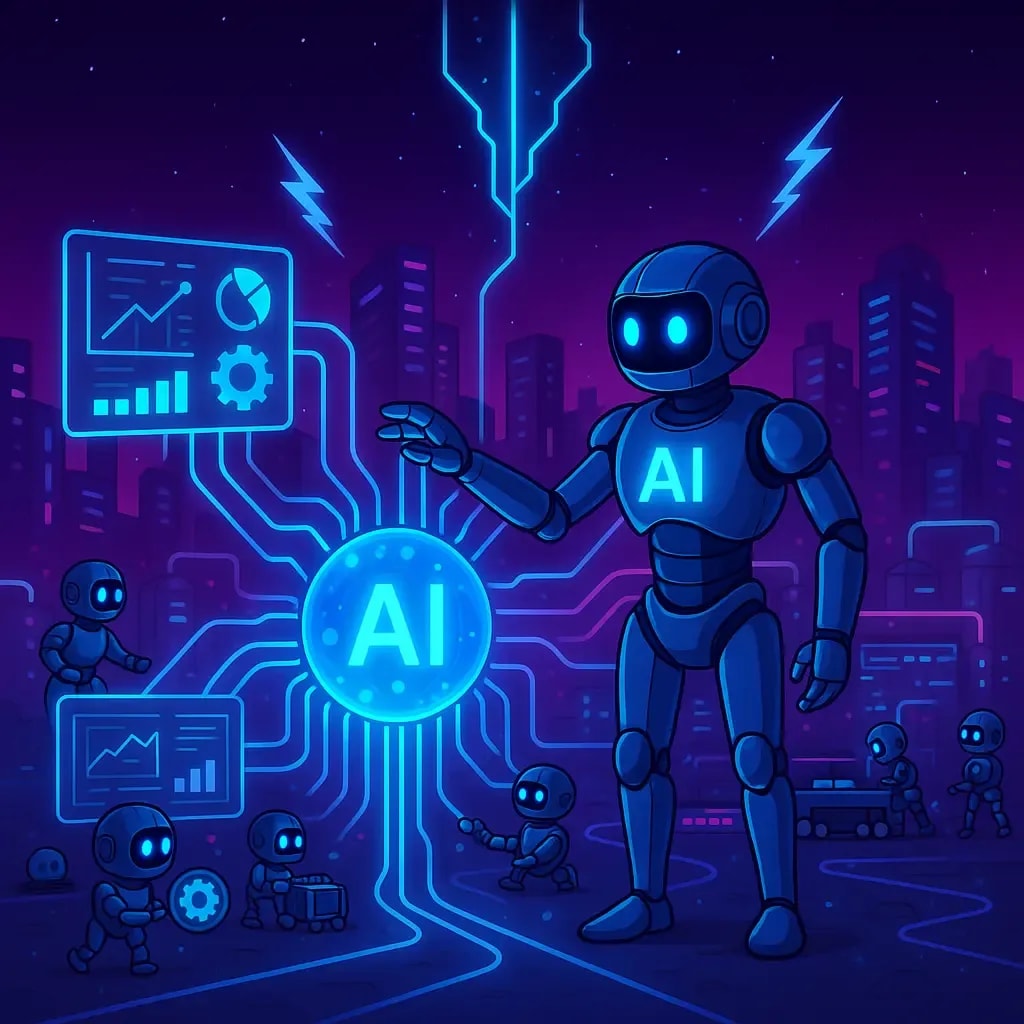
AI is shifting from a standalone “project” to an invisible utility layer that quietly powers how work gets done, much like electricity or network connectivity. For CIOs, CTOs, and CISOs, the question is no longer whether to use AI, but how to wire it into the enterprise stack so every process can tap into it safely and at scale.
Every major technology wave eventually becomes a utility. Electricity moved from on‑prem generators to grid power. Connectivity moved from private lines to always‑on broadband and Wi‑Fi. AI is now on the same path: embedded into every workflow, application, and decision, providing ambient intelligence without asking users to “go to an AI tool.”
AI as a Utility
A utility is reliable, metered, and ubiquitous. AI is rapidly evolving in that direction across three dimensions:
- Always‑on: Modern platforms run models continuously behind search, routing, pricing, personalization, and support, not as ad hoc pilots.
- Metered and scalable: Model calls, vector queries, and GPU time are becoming metered resources similar to CPU and storage, with unit costs declining as hardware and efficiency improve.
- Abstracted from end users: Employees see faster answers, better recommendations, and fewer errors, while orchestration, model management, and governance live in the platform layer.
Instead of buying “AI projects,” enterprises are wiring in an AI utility that can be reused across functions, products, and business units.
Industry-by-industry impact
Banking and financial services
Banks are using AI and gen AI to cut operating costs, improve productivity, and rewire credit, servicing, and operations.
- McKinsey estimates AI can trim banking industry costs by up to 20 percent as adoption scales across the stack.
- In one bank, gen AI for software development boosted developer productivity by about 40 percent and accelerated time to market.
- Multiagent AI systems in credit analysis showed 20 to 60 percent productivity gains for credit analysts and about 30 percent faster decision making, while also improving risk insight.
Near term, the utility layer shows up as AI copilots for operations, contact centers, and credit underwriting; longer term, it becomes a shared intelligence fabric that prices risk, orchestrates workflows, and powers real‑time, hyper‑personalized banking.
Insurance
AI and automation are transforming underwriting, claims, and fraud detection.
- Gartner‑cited figures show AI can reduce insurance claims processing times by around 30 percent and cut the cost of claims processing by up to 40 percent, while raising customer satisfaction.
- AI‑powered claims automation and fraud analytics can reduce claims handling costs by up to 30 percent and drive additional savings by preventing fraudulent payouts.
In the near term, AI utilities handle document ingestion, triage, and fraud flags; long term, they become shared services that continuously learn from the book of business, dynamically adjust risk pricing, and orchestrate end‑to‑end, low‑touch claims experiences.
Healthcare
Healthcare has enormous cost and productivity upside from AI as a utility for documentation, triage, diagnostics, and operations.
- Studies estimate that wider AI adoption could save roughly 5 to 10 percent of US healthcare spending, equating to about 200 to 360 billion dollars annually in recent‑year terms.
- AI can raise healthcare productivity by 5 to 10 percent within about five years, cut emergency visits and hospitalizations significantly, and reduce medical errors by over 80 percent in some use‑case analyses.
Near term, AI utilities power scribing, coding, prior authorization, and imaging triage; longer term, they become a clinical and operational fabric that coordinates care, optimizes resource usage, and supports earlier interventions at population scale.
Retail and eCommerce
In retail, AI utilities sit beneath personalization, pricing, merchandising, and service.
- Companies using AI‑driven personalization often see 10 to 20 percent revenue lift, with some reporting around 20 percent higher sales from personalization alone.
- AI personalization can boost retail profits by about 15 percent and cut marketing costs by roughly 20 percent, while AI‑driven recommendations now drive more than one‑third of some e‑commerce revenue.
Near term, this looks like recommendation services, search ranking, and campaign optimization; long term, it becomes a continuous learning utility that shapes every interaction, from demand forecasting to supply chain and in‑store experiences.
Manufacturing
Manufacturers are embedding AI into quality, predictive maintenance, and supply chain.
- Analytical AI is delivering cost reductions in service operations and production, while predictive maintenance and quality analytics reduce downtime and scrap.
- AI‑driven automation and robotics reduce manual inspection, optimize production schedules, and help maintain higher equipment uptime, which directly improves margins.
In the near term, AI utilities run anomaly detection on sensor data and automate visual inspection; long term, they become a decision layer that continuously balances throughput, cost, and risk across plants and suppliers.
Telecom
Telecom operators deploy AI for network optimization, customer care, and field operations.
- AI‑driven automation tools reduce manual network operations work, support AIOps for faster incident detection, and help cut operating costs.
- Predictive analytics improve capacity planning and fault management, leading to better uptime and fewer truck rolls.
Near term, AI utilities power chatbots, ticket triage, and basic AIOps; longer term, they orchestrate self‑optimizing networks and dynamic, intent‑driven services across 5G and edge environments.
Energy and utilities
AI is already recognized as a key lever to modernize grids and energy systems.
- AI for grid optimization and smart grids can significantly cut energy waste and reduce costs by improving demand forecasting, automating load balancing, and optimizing storage.
- One major international initiative estimates that AI‑driven power grid optimization could unlock up to about 300 billion dollars in efficiency gains globally within this decade.
Near term, AI utilities assist with forecasting, congestion management, and predictive maintenance; longer term, they form a real‑time intelligence layer coordinating distributed generation, storage, and demand response across millions of assets.
Transportation and logistics
Logistics and mobility depend on optimization and prediction, which are natural fits for AI utilities.
- AI optimizes routing, fleet utilization, and warehouse operations, reducing fuel consumption, labor costs, and delivery times.
- Predictive analytics lower maintenance costs and improve uptime for fleets and transport infrastructure.
Near term, AI runs under routing engines, slotting, and dispatch systems; longer term, it becomes a continuous optimization utility coordinating multimodal networks, autonomous assets, and dynamic pricing.
Media and entertainment
Media companies use AI as an always‑on engine for content discovery, recommendations, and production support.
- Strong personalization leaders in media and digital often generate around 40 percent more revenue from those capabilities than peers that lag.
- Recommendation engines can account for a large share of viewership and sales, translating directly into higher engagement and ad or subscription revenue.
Near term, AI utilities drive search, recommendations, and ad targeting; longer term, they support content generation, localization, and rights optimization at scale.
Government and public sector
Governments are applying AI to service delivery, operations, and policy analytics.
- Early fiscal modeling suggests that productivity gains from generative AI could reduce government budget deficits by hundreds of billions of dollars over a decade through more efficient administration and service delivery.
- AI helps automate case processing, eligibility checks, document classification, and citizen inquiries, cutting cycle times and improving consistency.
Near term, AI utilities support digital front doors, back‑office automation, and policy analysis; longer term, they become shared services across agencies, standardizing how data and workflows are processed while maintaining strong governance.
The economics of AI as a utility
AI as a utility pays off through both cost savings and new value creation.
Key economic levers include:
- Labor and workflow automation: Across sectors, AI reduces manual effort in document processing, support, and analysis, with measured productivity gains of 20 to 60 percent in targeted use cases.
- Operating cost reductions: In banking and insurance, AI‑enabled automation and analytics can cut operating costs and claims processing costs by up to 20 to 40 percent in some areas.
- Revenue lift: In retail, media, and digital services, AI‑driven personalization often delivers 10 to 20 percent revenue uplift and meaningful margin gains.
At the infrastructure level, hardware and model efficiency improvements are lowering the cost per unit of AI computation, even as overall demand and capacity investments rise. Over time, this mirrors the path of compute and storage: unit costs fall, consumption soars, and AI becomes a standard line item in IT and business P&Ls rather than a special project budget.
AI in the enterprise stack
For enterprises, AI is joining networking, storage, and virtualization as a foundational layer. Several shifts define this new utility stack:
- Private AI infrastructure: To control cost, latency, and data exposure, companies are building private AI platforms that combine on‑prem, private cloud, and VPC‑hosted models with open‑weight and commercial models.
- Agentic automation: Multiagent systems are emerging to coordinate complex workflows such as credit memo preparation or IT issue resolution, delivering large productivity gains.
- Multi‑model ecosystems: Enterprises are mixing large foundation models, domain‑specific models, and small task models, routing workloads dynamically based on cost, latency, and accuracy needs.
- Rapid deployment cycles: Modern AI platforms aim for weeks, not years, from idea to impact, with reusable components, APIs, and templates driving reuse.
- No‑code orchestration: Business and operations teams are increasingly able to configure and orchestrate AI workflows without writing code, similar to how they adopted low‑code for process automation.
- Secure, governed services: Policy, observability, model catalogs, and guardrails are being centralized to ensure compliant, auditable AI use across the enterprise.
This utility model reduces dependency on massive, multi‑year transformation programs and shifts focus to continuous, incremental deployment of AI capabilities that plug into existing systems and processes.
How enterprises should prepare
To treat AI as a utility, leadership teams can focus on five moves.
- Define the AI utility layer
- Prioritize high‑ROI workflows
- Invest in reliability, SRE, and AIOps
- Modernize data and legacy systems pragmatically
- Build governance and trust from day one
Final call to action
AI will not remain a boutique capability for long; it is becoming the invisible utility that powers how work gets done across every industry. Leaders who act now to design an enterprise AI utility layer, rather than chase isolated pilots, will capture the cost savings, productivity gains, and resilience benefits while setting the foundation for the next decade of digital transformation.