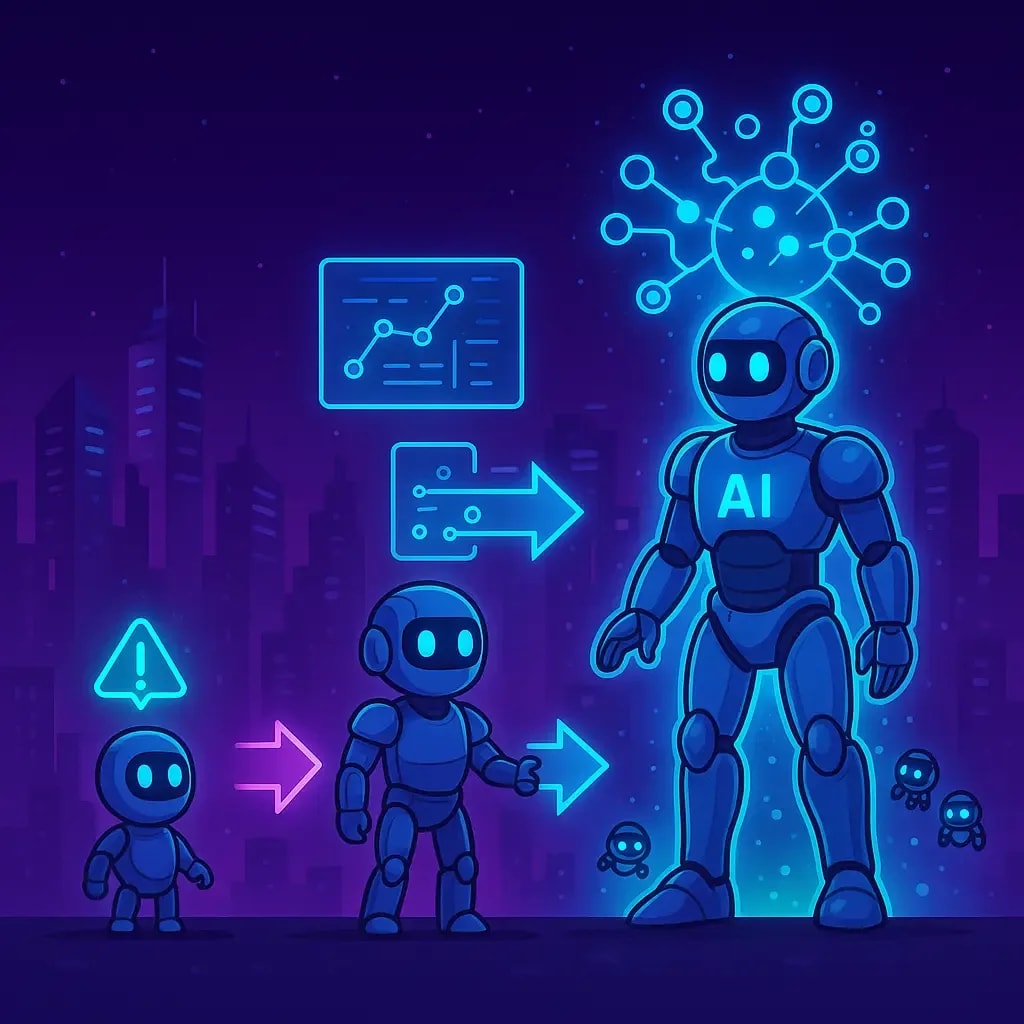
In today’s fast-moving enterprise world, AI agents have become the cornerstone of intelligent automation. Unlike traditional chatbots or rule-based scripts, true AI agents can perceive their environment, reason, decide, and act autonomously to achieve specific outcomes. Understanding the different types of AI agents – from the simplest to the most sophisticated – is crucial for enterprises looking to deploy agentic AI at scale.
As Program Manager at lowtouch.ai, I’ve seen firsthand how organizations move along this maturity curve: starting with basic reflex agents for ticket triage and rapidly evolving toward fully autonomous learning agents that orchestrate entire business processes. Let’s break down the five classic types of AI agents, their key characteristics, and real-world enterprise applications.
Key Characteristics That Define a True AI Agent
Before diving into the types, every robust enterprise AI agent shares these foundational traits:
- Autonomy: operates without constant human intervention
- Reactivity: perceives the environment and responds in real time
- Proactivity: takes initiative toward goals rather than just reacting
- Adaptability: learns and improves over time
- Social ability: collaborates with humans and other agents securely
- Persistent identity: maintains context and memory across sessions
- Tool use: directly interacts with APIs, databases, and legacy systems
The more of these traits an agent possesses, the higher it sits on the complexity ladder.
Simple Reflex Agents – “If This, Then That” on Steroids
Simple reflex agents are the most basic form. They react to the current perception only, with no memory or understanding of history.
How they work: Condition → Immediate Action rules. No internal world model, no planning.
Real-world enterprise example: An IT help-desk agent that instantly resets a user’s password when it sees the exact phrase “I forgot my password” in an incoming email or ticket. It doesn’t remember past interactions or check if MFA needs re-enrollment – it just fires the reset link.
- Pros: Lightning fast, zero latency, extremely reliable for narrow repetitive tasks.
- Cons: Completely blind to context. If the user wrote “My colleague forgot his password,” the agent would still trigger a reset for the wrong person.
Perfect starting point for enterprises beginning their agentic journey on platforms like lowtouch.ai.
Model-Based Reflex Agents – Adding an Internal World View
These agents maintain an internal model of the world to handle partial observability and hidden state.
How they work: They keep track of unseen aspects (e.g., “last password reset was 5 minutes ago”) and combine current perception + internal state → action.
Real-world enterprise example: A service-desk agent monitoring Jira tickets. When a new comment appears saying “still waiting,” the agent checks its internal model (“I escalated this to L2 support 4 hours ago”) and automatically posts “I’ve pinged the L2 team again and added high priority” instead of blindly re-escalating.
This small addition of state dramatically reduces noise and duplicate work.
Goal-Based Agents – Moving from Reaction to Intention
Goal-based agents introduce search and planning. They don’t just react – they evaluate which action moves them closer to a defined goal.
How they work: Current state + goal state → generate possible action sequences → choose the best path.
Real-world enterprise example: An onboarding agent whose goal is “new employee is fully productive on day 5.” When HR creates a new hire record, the agent doesn’t just send a welcome email. It proactively:
- Provisions a laptop via ServiceNow
- Creates accounts in Okta and Salesforce
- Book calendar slots for training
- Orders swag, and access card
- Follows up if any step is stuck
If the laptop shipment is delayed, it automatically books a loaner device and updates the new hire. All driven by the single goal of “ready by day 5.”
This is where enterprises start seeing true ROI from agentic systems.
Utility-Based Agents – When There’s More Than One “Good” Outcome
Sometimes multiple paths achieve the goal, but one is clearly better. Utility-based agents assign a utility score to each possible future state and pick the highest.
How they work: State → Utility function → Maximize expected utility.
Real-world enterprise example: A customer support escalation agent deciding whether to:
- Assign to the next available L2 engineer (fastest)
- Assign to the engineer who previously solved similar issues for this customer (highest CSAT)
- Keep in L1 with additional knowledge articles (cheapest)
The agent calculates a weighted utility (80% CSAT + 15% speed + 5% cost) and routes accordingly. During the month-end close, it might temporarily shift weights toward speed. During a product outage, toward expertise.
This nuanced trade-off capability is essential for mature enterprise automation.
Learning Agents – The Holy Grail of Enterprise AI
The most advanced agents don’t just plan – they improve themselves over time.
A learning agent has four components:
- Performance element: takes actions (like the agents above)
- Critic: evaluates how well it’s doing
- Learning element: modifies behavior based on feedback
- Problem generator: suggests exploratory actions
Real-world enterprise example: An SRE agent responsible for cloud cost governance. Initially, it cancels idle dev VMs after 2 hours (goal-based rule). Over months, it observes:
- Data-science team complains because long-running experiments are killed
- Finance praises 18% monthly savings
The learning loop adjusts policy: idle >2 hrs AND not tagged “experiment” AND CPU <5% → terminate. It even begins suggesting reservation purchases when it detects predictable nightly ML workloads.
After a year, the same agent evolves from blunt cost-cutter to intelligent financial co-pilot – entirely through self-learning within the enterprise’s private environment.
Why This Evolution Matters for Enterprises in 2025 and Beyond
Most organizations today are still stuck at level 1 or 2 (reflex agents hidden inside chatbots). Forward-thinking enterprises are racing toward levels 4 and 5 because:
- The complexity of business processes is exploding
- Customer and employee expectations for speed and personalization are rising
- Security and compliance demand that data never leave your perimeter
- Developer bandwidth can’t keep up with automation demand
This is exactly why we built lowtouch.ai as a no-code agentic platform that lets you start with simple reflex agents today and seamlessly evolve them into utility-based and learning systems tomorrow – all running 100% inside your own infrastructure, with full SSO, audit trails, and private model hosting.
Whether you want to:
- Auto-triage and resolve 70% of help-desk tickets
- Orchestrate employee onboarding end-to-end
- Run autonomous cloud cost optimization
- Let non-technical domain experts create their own digital workers
…you can begin small and grow sophisticated without ever rewriting code or moving data to the public cloud.
Final Thought
The future doesn’t belong to companies that deploy one super-complex agent. It belongs to those who can deploy hundreds of agents that start simple and continuously learn – securely, compliantly, and at enterprise scale.
That future is here today.
If you’re ready to move beyond basic bots and build a true agentic enterprise, let’s talk. Drop me a connection request or message – I’d love to explore how lowtouch.ai can accelerate your journey from reflex rules to autonomous intelligence.