As someone who works with enterprise teams every day at lowtouch.ai, I often hear the same questions:
Is an LLM an agent? What’s the difference between an AI workflow and an AI agent? And is “agentic AI” really that different from the AI we’ve been using for years?
These questions make sense. The AI ecosystem keeps moving fast, new terms show up each month, and many sound like they mean the same thing. But they don’t. And understanding the difference matters—especially for enterprises that want to automate safely, scale efficiently, and stay compliant.
What an LLM Actually Is
An LLM—Large Language Model—is a text engine. You ask for something, and it replies. That’s it. It doesn’t act unless you prompt it. It can’t fetch private data unless you give it that data. And it can’t take initiative.
How an LLM behaves
You type a question like:
“Translate this line into French.” It translates it.
But it won’t do anything beyond that. It won’t check your last email or pull information from your calendar unless you explicitly provide that data in the prompt.
That is the core limitation of an LLM:
It only knows what it has been trained on—and what you give it right now.
Real-world example (simple and platform-neutral)
Imagine a support analyst who copies and pastes a customer message into a chat window and asks the model to draft a response. The LLM does it well. But it can’t fetch your ticket ID, check past conversations, or update a record unless you manually paste all the details.
Useful? Yes.
Autonomous? Not at all.
What an AI Workflow Is
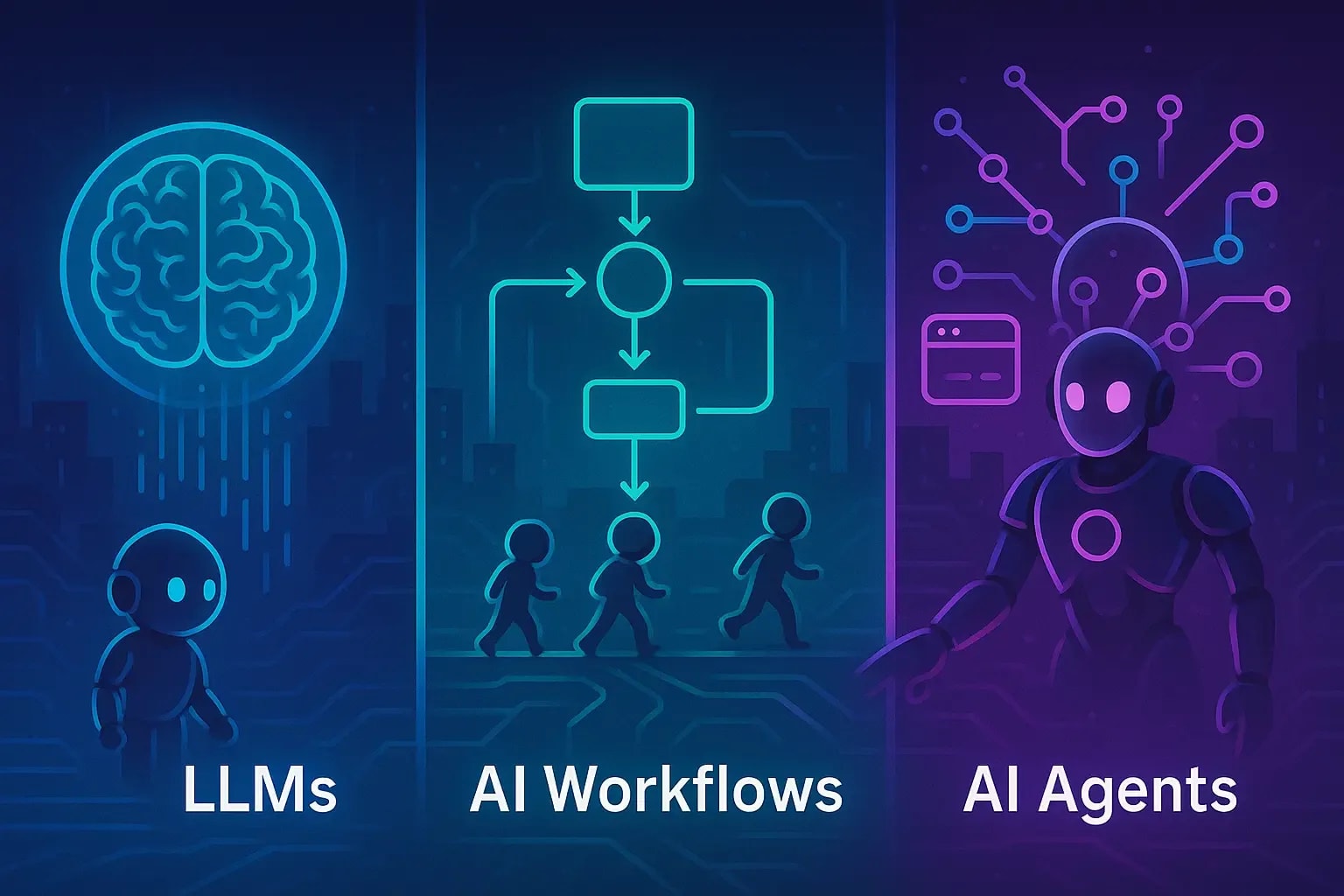
If an LLM is the “brain,” then an AI workflow is the “assembly line.”
An AI workflow links steps together so data flows from one system to another. It automates a path that you design.
How a Workflow Behaves
A workflow might:
- pull your latest email from a system,
- send its content to an LLM for translation,
- show the translated output to the user.
The steps are fixed. The order is fixed. The logic is fixed.
A workflow doesn’t “think” or “decide.”
It runs exactly as designed. If a task wasn’t part of the workflow, it can’t improvise.
Real-world example
Picture an HR process where a new employee joins. A workflow might:
- create an onboarding ticket,
- generate accounts,
- send a welcome email.
But if the new employee asks for access to a tool not included in the workflow, nothing happens. A human must step in or the workflow must be redesigned. Workflows don’t adapt on the fly.
This is why traditional automation feels rigid. It’s predictable but not flexible.
Where AI Agents Come In
AI agents are different.
- They don’t wait for instructions.
- They don’t follow a rigid script.
- They don’t need every step predefined.
Agents have a goal.
- They observe their environment.
- They take actions to reach that goal.
- They learn from the outcome.
This is what makes agentic AI a major shift for enterprise teams.
How an agent behaves
An agent can:
- Read an email asking for a meeting,
- Understand what the sender wants,
- Check your calendar,
- Look for open slots,
- Draft a reply,
- Suggest locations,
- Check the weather for that location,
- And prepare a final confirmation—
all based on reasoning, not a fixed workflow.
You didn’t list these steps for the agent.
The agent planned them.
Real-world example
Think of an IT support agent. Someone reports a performance issue. Instead of following a fixed ticketing workflow, an agent might:
- Read the incident,
- Check logs,
- Review recent deployments,
- Compare performance metrics,
- Identify the likely cause,
- Take an approved action,
- Update the ticket,
- Notify stakeholders.
It does this based on reasoning. If the situation changes tomorrow, the agent adapts—without a new flowchart.
That’s the difference between static automation and agentic automation.
Agentic vs Non-Agentic AI
Everything before agents—LLMs, scripts, chatbots, workflows—is non-agentic AI. It reacts. It executes. It does not initiate.
Non-agentic AI
- waits for instructions
- operates only within predefined logic
- cannot plan or explore beyond what’s given
Agentic AI
- takes initiative
- breaks down goals into steps
- chooses the right tool or system
- adapts when things change
- learns from feedback
This gap is not small. It’s the difference between typing instructions into a tool and working with a digital team member.
How These Fit Together
Enterprises often ask: “Do we replace everything with agents?” Not at all. In practice, these three layers work best together.
LLMs
Provide reasoning and language skills.
AI workflows
Connect systems cleanly and handle predictable sequences.
AI agents
Take goals, decide what to do, and call LLMs and workflows as needed.
Think of it like this:
- LLMs answer questions.
- Workflows automate fixed tasks.
- Agents solve problems and complete goals.
This is exactly how modern no-code agentic platforms like lowtouch.ai are shaped—LLMs inside, workflows around them, agents orchestrating the full environment.
Why Enterprises Struggle Without Agents
Enterprises already use LLMs and workflows. But these have limits that show up quickly:
- Static automation breaks easily
When a process changes, workflows have to be redesigned. Teams spend weeks tuning rules and conditions.
- LLMs alone can’t access enterprise data
They respond to prompts but can’t look up a ticket, review a document, or check monitoring dashboards unless data is manually shared.
- Legacy systems don’t integrate well
Point-to-point scripts become brittle. Data from old apps stays siloed.
- Human teams fill the gaps
Most “automation” projects still rely heavily on people to monitor, validate, or complete steps.
Agents solve these problems because they:
- understand context,
- connect to systems through APIs and credentials,
- evaluate options,
- and execute actions securely within boundaries.
That’s why agentic AI is turning into the natural next layer of enterprise automation.
Where Agents Make the Biggest Impact
- Business Process Optimization
Agents can handle long-running, cross-system tasks without hardcoded logic.
Example: A finance agent can read invoices, validate details, check policy exceptions, and update records—without needing a fixed workflow for every variant.
- Customer Experience
Customer teams often deal with unstructured requests.
Agents help by understanding intent, pulling CRM context, drafting responses, and taking actions like updating records or escalating issues.
- Help Desk and IT Support
This is where the difference becomes obvious.
Every ticket is slightly different. Workflows struggle here. Agents don’t.
They can diagnose, correlate incidents, inspect logs, and resolve routine issues on their own.
- SRE and Cloud Operations
Teams spend hours watching dashboards. Agents can watch for them.
They can analyze anomalies, initiate troubleshooting, and trigger repair actions within guardrails.
This is why platforms like lowtouch.ai focus on secure, enterprise-grade agent design—because autonomy without compliance is a risk. But autonomy with guardrails is a superpower.
A Balanced View: Agents Are Powerful, But Not Magic
Agentic AI doesn’t replace humans. It replaces repetitive decision-making.
It handles the heavy lifting so teams can focus on strategy, architecture, customer outcomes, and innovation.
But you must design agents with:
- boundaries
- permissions
- identity-aware access
- observability
- memory controls
- private model hosting
This is the philosophy behind the lowtouch.ai appliance—agents that run inside your network, act with your SSO identity, and follow your security rules.
A Simple Way to Distinguish Them
If you want a quick rule of thumb, use this list:
- LLM → Answers when asked.
- Workflow → Follows a fixed path.
- Agent → Finds the path.
What This Means for the Future of Enterprise Automation
For years, automation meant writing scripts, building workflows, or stitching tools together. It worked, but it never handled real complexity.
LLMs expanded what machines could understand—but didn’t give them initiative.
Agents bring the missing piece:
the ability to think, act, and adapt.
And when you combine agents with a no-code platform that keeps data private, integrates with enterprise systems, and provides auditability, enterprises finally get what they’ve been asking for:
- Automation that learns,
- Systems that can reason,
- Processes that improve themselves,
- And operations that scale without more headcount.
This is why agentic AI isn’t a trend—it’s the new foundation for enterprise automation.
Final Thoughts
Whether you’re modernizing workflows, improving customer experience, or bringing AI into IT operations, understanding the differences between LLMs, workflows, and agents helps you choose the right tool for the job.
- LLMs are great for reasoning and language.
- Workflows handle predictable processes.
- Agents deliver autonomy, flexibility, and real impact.
As enterprises move toward deeper automation, agentic AI will become the standard. And platforms like lowtouch.ai make that shift possible without code, without complexity, and without compromising privacy.
If you’re exploring how agents can fit into your roadmap, I’m always happy to connect and share what we’re seeing in the field.