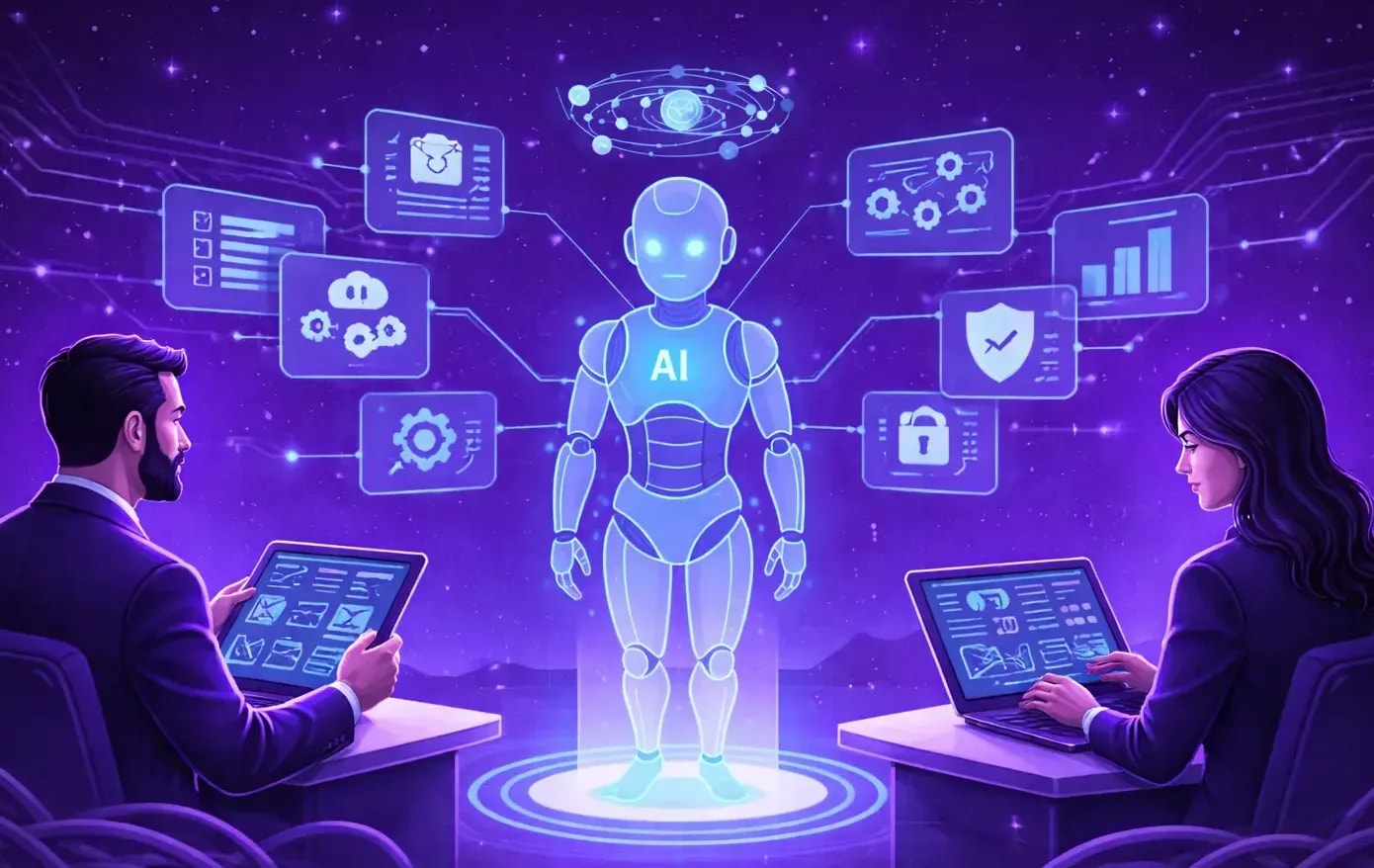
As enterprises accelerate digital transformation, AI agents are emerging as a foundational capability for business automation, operational efficiency, and intelligent decision-making. Unlike traditional automation, AI agents can reason over context, act across systems, and continuously adapt to changing business conditions.
Understanding how to implement AI agents in business is now a strategic priority for leaders across operations, IT, customer experience, and platform engineering. Success depends not on experimentation alone, but on a structured, enterprise-ready approach grounded in governance, data trust, and real operational value.
This guide explains how enterprises can implement AI agents responsibly and effectively—turning them into reliable digital workers that scale with the business.
What Are AI Agents in an Enterprise Context?
AI agents are autonomous or semi-autonomous systems designed to observe inputs, reason over information, and take actions aligned with defined objectives. In an enterprise environment, they operate across workflows, applications, and data sources while respecting security, compliance, and organizational boundaries.
Unlike static bots or rule-based automation, agentic AI systems are adaptive. They can make contextual decisions, collaborate with humans, and improve through continuous learning.
Step One: Define Clear Business Outcomes
Every successful AI agent implementation starts with a clearly articulated business goal. Without this clarity, AI initiatives risk becoming fragmented or misaligned with enterprise priorities.
Leaders should define the outcome the AI agent is expected to influence—such as operational efficiency, service quality, or system reliability. This clarity ensures alignment across stakeholders and establishes a measurable definition of success.
Clear business objectives also guide agent design, data requirements, and escalation boundaries.
Real-world scenario
A customer service organization focused on improving response consistency during high-volume periods. By anchoring the AI agent around experience quality rather than speed alone, the solution balanced automation with intelligent human escalation.
Step Two: Select the Right AI Agent Use Cases
Not all enterprise processes benefit equally from AI agents. The strongest use cases typically involve repetitive decisions, high information volume, or continuous monitoring requirements.
Organizations should evaluate workflows where manual effort introduces delays, inconsistencies, or operational risk. AI agents excel where decisions must be made quickly and consistently across systems.
Starting with focused, high-impact use cases helps demonstrate value early and builds internal confidence.
Real-world scenario
An internal IT team reduced service backlog by introducing an AI agent to manage routine access requests, enabling engineers to focus on higher-priority initiatives
Step Three: Build a Strong Data Foundation
AI agents depend on trusted data to reason effectively. Data quality, accessibility, and governance are critical to enterprise-grade AI agent implementation.
Organizations must understand where relevant data resides, how it flows between systems, and how access is controlled. Ensuring data consistency and security is essential for both performance and compliance.
Data readiness is an ongoing discipline rather than a one-time activity.
Real-world scenario
A finance operations team discovered fragmented vendor records while preparing an AI agent for invoice review. Addressing these inconsistencies improved automation accuracy and reduced downstream exceptions.
Step Four: Choose the Right Agent Design Model
AI agents can range from simple reactive systems to advanced reasoning-driven digital workers. Selecting the appropriate design depends on task complexity and risk profile.
Straightforward workflows benefit from deterministic agents, while complex scenarios require agents capable of contextual reasoning and adaptive decision-making.
Right-sizing agent intelligence avoids unnecessary complexity while ensuring reliability.
Real-world scenario
A sales support agent initially handled basic inquiries before evolving to adapt responses based on changing business context and customer needs.
Step Five: Integrate AI Agents Into Enterprise Systems
AI agents deliver the most value when embedded within existing enterprise workflows. Seamless integration with applications, knowledge systems, and operational tools allows agents to act meaningfully rather than operate in isolation.
Secure connectivity ensures agents can retrieve information, trigger actions, and collaborate with human teams without disrupting established processes.
Real-world scenario
An HR onboarding agent coordinated policy access, approvals, and communications by integrating across internal systems, reducing manual follow-ups.
Step Six: Prioritize Human-Centered Interaction
Adoption depends on trust. AI agents must communicate clearly, predictably, and transparently to earn confidence from users.
Designing intuitive interactions and refining agent responses based on real usage ensures alignment with human expectations. Feedback loops are essential for continuous improvement.
Real-world scenario:
A knowledge assistant improved adoption after shifting from verbose explanations to concise, context-aware responses.
Step Seven: Deploy Gradually and Iterate Continuously
Enterprise AI agent implementation should follow a phased rollout strategy. Early deployments surface edge cases that are difficult to predict during design.
Iterative refinement ensures agents evolve alongside business needs while minimizing operational risk.
Real-world scenario
An operations monitoring agent improved reliability after refining escalation logic discovered during early deployment.
Step Eight: Monitor Performance and Maintain Governance
AI agents require continuous monitoring to ensure alignment with business objectives, compliance standards, and ethical guidelines.
Performance metrics should measure real business outcomes, supported by qualitative human review.
Governance frameworks define accountability, escalation, and oversight responsibilities.
Real-world scenario
A compliance agent flagged potential risks while final decisions remained under human review, ensuring contextual judgment.
Step Nine: Enable Continuous Learning and Adaptation
AI agents must adapt as enterprises evolve. Regulatory changes, system updates, and new data sources require agents to be continuously refined.
Treating AI agents as long-lived digital workers ensures sustained value rather than short-term automation gains.
Real-world scenario
A supply chain agent maintained accuracy by adapting to evolving vendor relationships and operational changes.
Final Thoughts: AI Agents as Digital Workers
Implementing AI agents in your business is not about replacing people—it is about amplifying human capability. When designed with intent, governance, and trust, AI agents become reliable digital workers that operate at enterprise scale.
Organizations that invest in thoughtful AI agent implementation today will be best positioned to operate faster, smarter, and more resiliently tomorrow.
Agentic AI represents the next evolution of enterprise automation—and those who implement it well will define the future of work.